


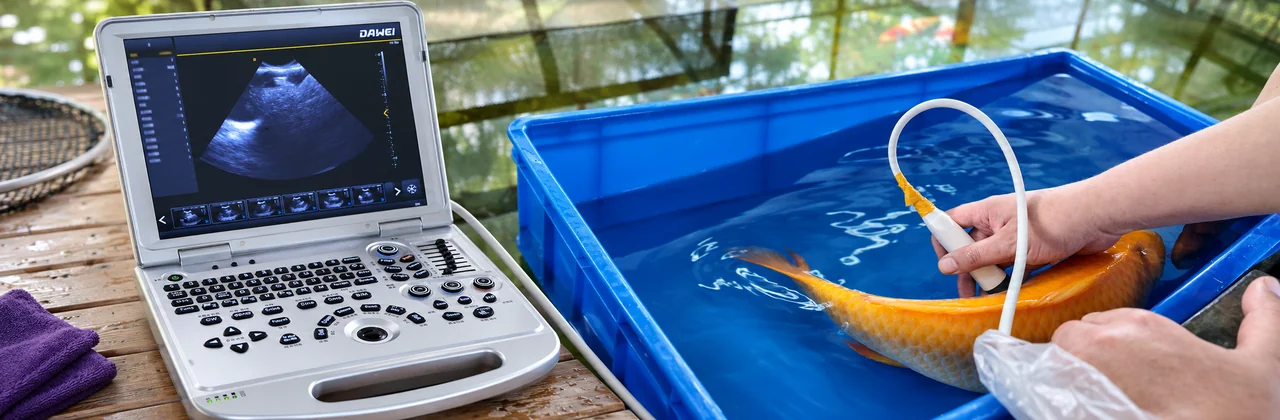
 Can ultrasound be used to examine fish roe without opening the fish? Yes. Veterinary ultrasound provides a non-invasive imaging method for observing internal reproductive structures and supporting fish ovarian development assessment.
In this real-world aquaculture application, the Dawei L3 portable veterinary ultrasound machine was used to examine a live fish for roe-related reproductive assessment. The examination demonstrates how real-time ultrasound imaging can support fish breeding management and reproductive monitoring.
Real Case: Fish Roe Assessment Using L3 Veterinary Ultrasound
Fish reproduction management is an important part of aquaculture, particularly for farms and breeding facilities that need to monitor ovarian development and select suitable broodstock.
Traditional reproductive assessment methods may involve invasive sampling or rely on external physical characteristics, which cannot always provide sufficient information about internal reproductive development.
In this demonstration, the Dawei L3 portable ultrasound system was used to perform an on-site fish examination.
Case Overview
- Equipment: Dawei L3 Portable Veterinary Ultrasound
- Application: Fish roe and ovarian development assessment
- Examination Mode: Real-time B-mode ultrasound
- Environment: Aquaculture facility
- Purpose: Non-invasive observation of internal reproductive structures
How Was the Fish Ultrasound Examination Performed?
The demonstration video shows a fish being examined in a water-filled container while an operator uses an ultrasound probe to obtain internal images.
The examination involves three main steps.
1. Fish positioning and preparation
The fish is carefully supported during the examination to allow access to the scanning area while minimizing unnecessary handling.
2. Ultrasound probe scanning
The operator positions the ultrasound transducer against the fish’s body to capture internal structures. Appropriate probe positioning and scanning parameters help obtain useful images for reproductive assessment.
3. Real-time ultrasound observation
The Dawei L3 displays grayscale B-mode ultrasound images during scanning. These images can be reviewed by a qualified professional to assess visible internal structures and investigate potential ovarian development.
The recorded demonstration shows the scanning procedure and real-time imaging. A confirmed egg count or ovarian maturity stage was not documented in this case.
Watch the Video: Dawei L3 Fish Roe Ultrasound Examination
[Insert the original fish ultrasound examination video here]
Video: On-site fish roe assessment using the Dawei L3 portable veterinary ultrasound machine, showing probe operation and real-time ultrasound imaging.
Why Use Ultrasound for Fish Roe Assessment?
Ultrasonography offers several potential advantages for aquaculture breeding and fish reproductive management.
Non-Invasive Reproductive Examination
Ultrasound allows internal structures to be examined without surgically opening the fish, making it useful for assessing valuable breeding stock.
Monitoring Ovarian Development
Ultrasound images may help trained professionals evaluate ovarian structures and monitor reproductive changes over time.
Supporting Broodstock Selection
Information obtained from ultrasound examinations can contribute to breeding decisions, female broodstock evaluation, and reproductive management planning.
Repeatable Examination
Because ultrasound imaging is non-destructive, examinations can be repeated when appropriate to monitor reproductive development at different stages.
These benefits depend on fish species, equipment configuration, image quality, handling procedures, and professional interpretation.
To learn more about how ultrasound supports fish reproductive assessment and breeding management, explore our fish ultrasound solutions for aquaculture and discover more real-world applications.
Why Choose the Dawei L3 for Aquaculture Ultrasound?
The Dawei L3 portable veterinary ultrasound system provides real-time imaging capabilities for veterinary examinations in different working environments.
For aquaculture applications, its portable design allows operators to conduct examinations near fish tanks or breeding facilities without requiring a fixed imaging room.
In fish reproductive assessment, suitable transducer selection, scanning depth, and imaging settings are important for obtaining useful images.
Beyond general veterinary applications, the L3 can be considered for fish abdominal examination, reproductive structure observation, and aquaculture research workflows.
Frequently Asked Questions About Fish Roe Ultrasound
Can ultrasound detect fish eggs?
Ultrasound can help visualize ovarian structures and egg-related reproductive development in certain fish species. However, the ability to identify eggs depends on their developmental stage, size, the fish species, and ultrasound image quality.
Can ultrasound determine whether fish roe is mature?
Ultrasound may provide information about ovarian development, but reliable maturity assessment requires species-specific knowledge, suitable imaging protocols, and professional interpretation. Ultrasound images alone do not always establish spawning readiness.
Can a veterinary ultrasound machine count fish eggs?
Ultrasound is generally more suitable for assessing ovarian structures and reproductive development than for determining the exact number of individual eggs. Exact egg counts should not be assumed from a standard ultrasound examination.
What ultrasound machine can be used for fish reproduction examinations?
Portable veterinary ultrasound systems, such as the Dawei L3, can be used for fish reproductive assessment when equipped with suitable probes and scanning settings. The appropriate configuration depends on the species and examination purpose.
Conclusion
This real aquaculture application demonstrates the use of the Dawei L3 veterinary ultrasound machine for fish roe examination.
By providing real-time, non-invasive imaging, ultrasound can support ovarian development observation, breeding management, and reproductive research in aquaculture.
The recorded examination illustrates a practical scanning workflow rather than a quantified clinical study.
Looking for the right ultrasound system for your veterinary or aquaculture applications? Explore Dawei’s comprehensive range of ultrasound for animals, including portable and color Doppler ultrasound systems designed for different animal species and clinical needs.
Post time: Nov-05-2026