


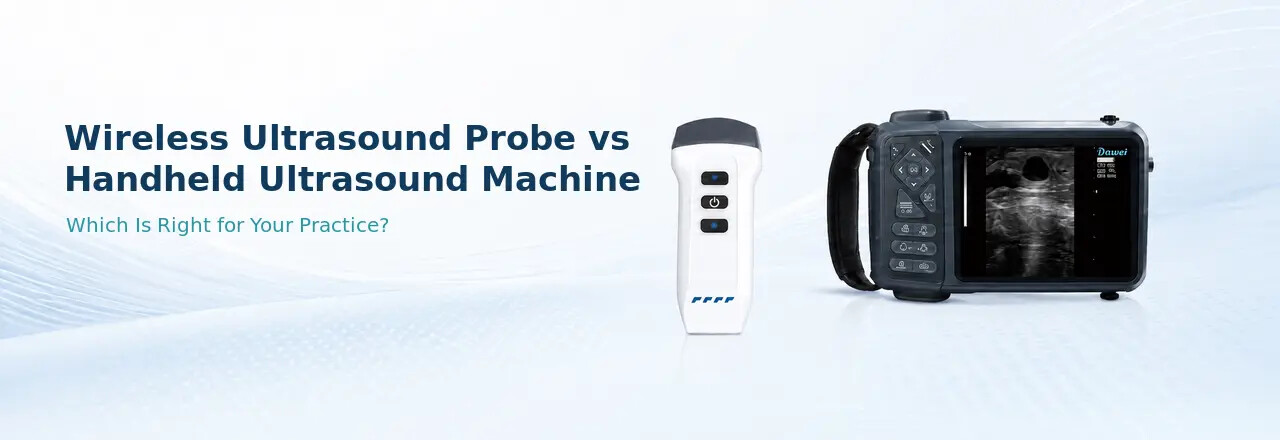
Portable ultrasound is no longer one single format. A veterinarian can now carry a probe that sends images to a phone or tablet, or choose a compact handheld machine with its own screen and controls. Both can fit into a mobile kit. Both can reduce the need to move a full-sized console. Yet in daily work, they feel very different.
That difference matters.
If you are comparing a wireless ultrasound probe for veterinary use with a handheld veterinary ultrasound machine, the better choice is not automatically the smaller device or the system with the larger specification list. The right choice depends on where you scan, which animals you examine, how long you work away from a clinic, and how much you want the ultrasound system to depend on a separate phone or tablet.
This guide breaks down those trade-offs in practical terms.
Quick answer: wireless probe or handheld ultrasound machine?
Choose a wireless ultrasound probe when maximum mobility is the priority and you are comfortable using a phone, tablet, or compatible computer as the display and control interface. It is especially attractive for rapid examinations, mobile veterinary work, point-of-care scanning, and situations where carrying less equipment makes a real difference.
Choose a handheld ultrasound machine with a built-in screen when you want a self-contained scanning workflow, dedicated physical controls, easier operation without relying on a separate smart device, or broader probe flexibility for repeated field and livestock examinations.
There is no universal winner. The real comparison is minimal hardware versus independent workflow.
What is a wireless veterinary ultrasound probe?
A wireless ultrasound probe combines the transducer and much of the imaging hardware into a compact probe-shaped device. Instead of using a built-in monitor, it sends ultrasound images to compatible external hardware—typically a smartphone, tablet, or computer.
That architecture removes a separate console from the veterinarian’s hand or bag. The result can be exceptionally compact.
For example, the Dawei DW-X1 veterinary wireless ultrasound probe connects over Wi-Fi to a mobile device or computer. The current configuration combines convex and linear scanning in a dual-probe design and supports color Doppler-related imaging modes. It is positioned for dogs, cats, pigs, sheep, and other small-to-medium animals.
The important point is not the model name, however. It is the workflow: probe + external display.
That can be wonderfully simple. It can also create a dependency. Your phone or tablet becomes part of the ultrasound system, so screen brightness, device compatibility, battery status, mounting, cleaning, and handling all enter the clinical workflow.
What is a handheld veterinary ultrasound machine?
A handheld ultrasound machine takes a different approach. The main unit includes its own display and controls, while one of several compatible probes connects to the device.
It is still portable—often very portable—but it works as a dedicated ultrasound system rather than as an accessory to a phone or tablet.
The Dawei Slite portable livestock ultrasound machine is a useful example. It has a 5.6-inch medical LED display, onboard storage, physical controls, USB export, a swappable battery, and multiple probe options. Depending on configuration, it can be used for routine abdominal, reproductive, superficial, and large-animal examinations.
This is the defining workflow: probe + dedicated handheld console.
Dawei also offers more specialized handheld veterinary ultrasound for sheep and pig pregnancy work and a full-digital handheld veterinary ultrasound platform for buyers comparing different levels of field-use capability.
For veterinarians who repeatedly scan animals in barns, breeding facilities, farms, or mobile service environments, that independence can be more valuable than shaving the last few hundred grams from the kit.
Wireless ultrasound probe vs handheld ultrasound machine: key differences
| Decision factor | Wireless ultrasound probe | Handheld ultrasound machine |
|---|---|---|
| Display | Uses a compatible phone, tablet, or computer | Built-in dedicated screen |
| Controls | Usually app-based touchscreen controls | Dedicated buttons/keys plus onboard interface |
| Carrying size | Extremely compact | Compact, but includes a display and control body |
| Cable management | Can eliminate the cable between probe and display | Probe normally connects to the handheld unit |
| Setup | Requires compatible external display and connection | Turn on the system and scan with the connected probe |
| Device dependency | Depends on phone/tablet/computer compatibility and battery | Main scanning workflow is self-contained |
| Probe flexibility | Depends heavily on the specific wireless probe design | Many systems support interchangeable probe types |
| Data viewing/sharing | Convenient on connected smart devices | Usually handled through onboard storage/export functions |
| Typical strength | Maximum mobility and fast access | Independent field workflow and broader configuration options |
| Best fit | Mobile, quick, point-of-care and space-limited scanning | Repeated field scanning, livestock work, reproduction and mixed workflows |
This table is a starting point, not a verdict. Individual products can cross these boundaries. A sophisticated wireless probe may offer functions a basic handheld unit does not, while a rugged handheld scanner may provide longer working time or more probe configurations than a wireless device.
So compare the actual systems—not just the form factor.
1. Portability: how portable do you really need to be?
Wireless probes win the pure size contest almost by definition. The scanner can slip into a small case, and the display may already be in your pocket.
For a mobile veterinarian moving between examination rooms, vehicles, kennels, shelters, or emergency locations, that is a genuine advantage. There is less equipment to set down, fewer pieces to position, and less friction between “I should scan this patient” and actually starting the examination.
But portability has two dimensions: what you carry and what you must manage.
With a wireless probe, the phone or tablet is part of the setup. You need somewhere safe to hold or place it. Outdoors, screen visibility matters. In a busy clinical setting, cleaning and device protection matter. During a long field day, the charge level of both devices matters.
A self-contained handheld machine is physically larger, but the workflow can be more predictable: one dedicated display, one control panel, one device designed specifically for scanning.
If you are still comparing other portable formats, Dawei’s guide to portable veterinary ultrasound machines also covers handheld, laptop-style, wireless, and compact systems.
2. Screen and controls: convenience is not the same as independence
A phone or tablet can provide a bright, familiar touchscreen and make images easy to review or share. For many veterinarians, that feels natural immediately.
It also means your ultrasound interface lives inside a general-purpose device.
Handheld systems use another philosophy. The screen is permanently attached to the scanner, while buttons and dedicated controls remain available during the examination. In wet, dusty, gloved, or repetitive farm work, physical controls can be easier to operate consistently than a touchscreen alone.
Neither approach is inherently more modern. They solve different problems.
Ask yourself a simple question: Do I want my phone or tablet to become part of every scan?
If the answer is yes, wireless can feel liberating. If the answer is no, the integrated screen of a handheld machine may be worth the additional size.
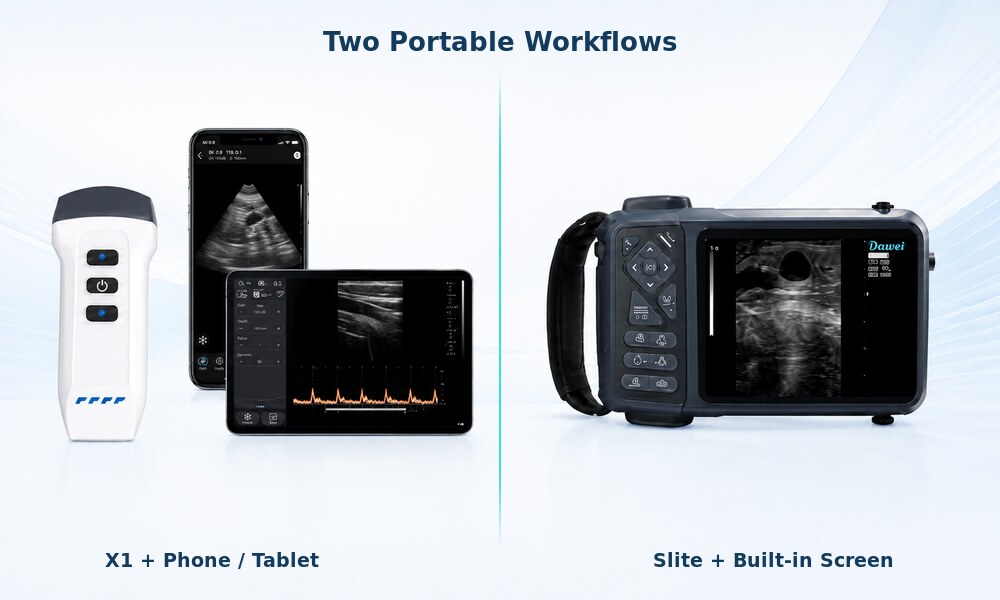
Figure 1. A wireless probe relies on an external display, while a handheld ultrasound keeps the main display and controls in a dedicated device.
3. Probe configuration: one compact tool or a flexible platform?
This is where buyers should slow down.
“Wireless” and “handheld” describe product architecture. They do not tell you which anatomy the machine can image well.
Probe geometry still matters.
A small-animal practitioner may want microconvex or convex access for abdominal examinations and a linear option for superficial structures. A bovine reproductive veterinarian may need a rectal probe. An equine practitioner could require linear scanning for tendons in one case and a reproductive probe in another.
Some wireless systems combine two scanning surfaces or offer different wireless probe models. The X1, for instance, combines convex and linear functionality in one dual-probe unit. That makes it compact without limiting the user to a single acoustic geometry.
Dedicated handheld systems can take a platform approach. Slite supports convex and linear configurations, with optional microconvex and rectal probes depending on the ordered setup. That flexibility matters when one machine must serve different animals or examination types.
The best question is not “How many probes are available?” It is “Does this system support the exact probe I use every week?”
4. Imaging features: do not judge capability by size alone
It is tempting to assume that a wireless probe must be basic and a handheld machine must be more powerful. That is not a reliable rule.
The current X1 configuration supports B-mode, B/M and Doppler-related modes including color flow and pulsed-wave functions. Slite is a B/W handheld platform with B, B+B, 4B, BM, and M display modes. In other words, these two example products are not simply the same imaging system in two different shells.
This is precisely why a good portable ultrasound comparison separates form factor from imaging requirements.
If blood-flow assessment is essential, confirm the required Doppler modes. If pregnancy detection is the priority, probe choice, depth, measurement packages, battery life, and outdoor handling may matter more. If cardiac diagnosis is central to your practice, a more advanced laptop or cart-based color Doppler system may be the more appropriate category altogether.
For companion-animal options across wireless, laptop, and cart formats, see Dawei’s pet ultrasound machine comparison.
5. Battery and long field sessions
Battery specifications deserve more attention than they usually get.
A wireless system involves at least two powered devices: the probe and the phone/tablet/computer used for display. A handheld machine integrates the display into the main unit, so there is only one primary scanning system to monitor, although accessories and spare batteries may still be part of the kit.
In the current Dawei specifications, the X1 uses a 1350mAh battery rated for at least two hours of continuous operation and supports wireless charging. Slite uses a swappable battery: the standard 2600mAh pack is listed at about three hours, while an optional 5200mAh pack is listed at about six hours under typical use.
Those numbers are product-specific, not universal category rules. Still, they illustrate the buying question clearly.
For a ten-minute abdominal check, either format may be easy to manage. For a long cattle reproductive session far from a power outlet, battery architecture and swap options become much more important.
6. Which is better for small-animal practice?
For dogs, cats, and other small-to-medium animals, a wireless probe can be an excellent mobile-first option. It occupies little space, can move quickly between rooms, and allows images to be displayed on familiar smart hardware.
The X1 is particularly relevant here because its dual probe combines convex and linear scanning and adds color Doppler functions in a compact format.
However, a small-animal clinic should not choose wireless simply because it is convenient. If the practice performs advanced echocardiography, detailed Doppler studies, high-throughput abdominal imaging, or needs multiple specialized probes, a laptop or cart system may better match the diagnostic workload.
Portability is valuable. It is not the only variable.
7. Which is better for cattle, horses, sheep, goats, and pigs?
For livestock and equine work, self-contained handheld machines often have a strong practical advantage: they are designed around repeated field scanning, dedicated controls, independent displays, and probe configurations selected for reproductive or general farm examinations.
Slite, for example, can be configured for large-animal reproduction and supports a rectal probe option as well as general convex/linear configurations. Its swappable battery and onboard storage also suit longer sessions away from a clinic.
That does not mean wireless is unsuitable for farms. Some wireless probes are designed specifically for livestock workflows. It means the decision should start with the examination route, animal species, working duration, and environment—not with the word “wireless.”
8. Which is better for mobile veterinarians?
This is the closest contest.
If you visit many locations and perform rapid scans, the extreme portability of a wireless probe is hard to beat. A compact probe plus a device you already carry can reduce setup time and bag weight dramatically.
If your mobile service includes long farm rounds, unpredictable environments, reproductive work, or repeated examinations requiring several probe types, a dedicated handheld system may be easier to standardize.
Think about the whole day, not the first scan.
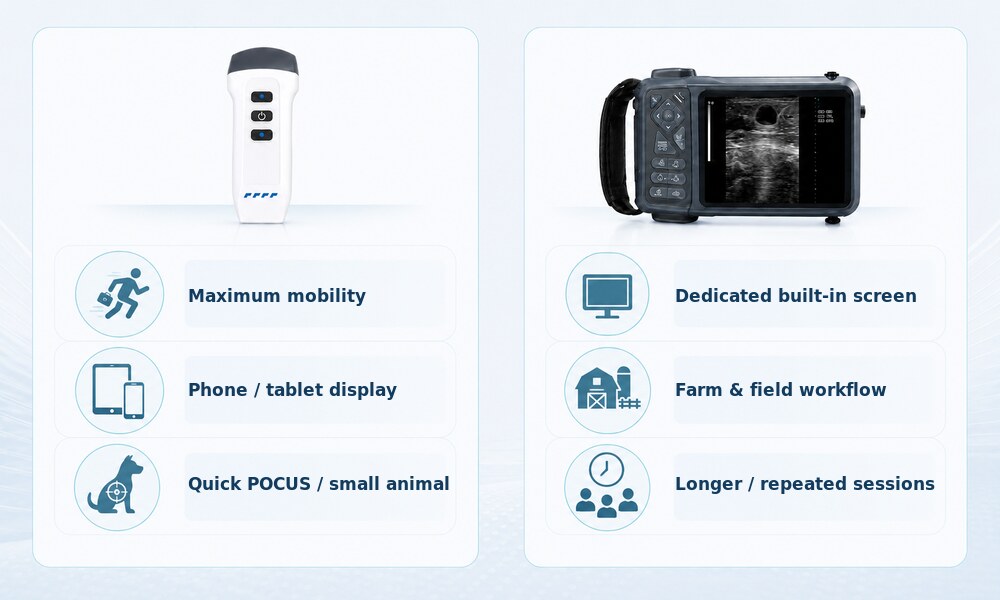
Figure 2. Choose by workflow: mobility, external-device dependence, animal species, examination type, probe requirements, and field duration.
Dawei example: X1 wireless probe vs Slite handheld ultrasound
The following comparison shows why form factor and clinical capability should be evaluated together.
| Feature | Dawei X1 Wireless Probe | Dawei Slite Handheld Ultrasound |
| Product format | Wireless probe | Self-contained handheld unit + probe |
| Main display | Compatible phone/computer | Built-in 5.6-inch medical LED |
| Connection/workflow | Wi-Fi to external device | Dedicated onboard interface |
| Probe arrangement | Dual convex + linear probe | Interchangeable configurations; convex/linear with optional microconvex/rectal |
| Imaging modes | B, B/M, CFM, PDI, PW and related modes | B, B+B, 4B, BM, M |
| Typical positioning | Small and medium animal mobile scanning | Livestock, mixed-animal, reproduction, farm/mobile work |
| Continuous operation | ≥2 hours listed | ~3 hours standard; ~6 hours optional battery listed |
| Data workflow | Display through connected smart device/computer | Built-in storage and USB export |
The X1 is compelling when compact color-capable scanning and mobile-device display are priorities. Slite makes more sense when a veterinarian wants a dedicated screen, physical controls, interchangeable probe options, and a longer self-contained field workflow.
For other configurations, browse Dawei’s broader wireless veterinary ultrasound range before deciding by form factor alone.
A seven-question buying checklist
Before requesting a quotation, answer these questions:
- Which animals do I scan most often? Dogs and cats create different probe requirements from cattle or horses.
- What examination do I perform most? Abdomen, reproduction, cardiac screening, tendons, and superficial structures are different ultrasound jobs.
- Do I want to use my phone or tablet during every examination? This is the central workflow question for wireless scanning.
- How long am I usually away from power? Compare the complete battery workflow, not only the scanner’s headline runtime.
- Which probe geometries do I actually need? Confirm convex, microconvex, linear, rectal, or other required options before buying.
- Do I need Doppler? Never assume that all portable systems have the same imaging modes.
- Where will the system be used? A clean consultation room, a mobile vehicle, and a cattle barn place very different demands on equipment.
Answer those seven questions and the choice becomes much easier.
Final recommendation
A wireless veterinary ultrasound probe is the strongest choice when your workflow rewards minimal equipment, fast access, phone/tablet viewing, and rapid mobile scanning. It can be remarkably convenient for small-animal work, quick checks, and point-of-care examinations.
A handheld veterinary ultrasound machine is often the better fit when you want a dedicated all-in-one scanning device, physical controls, flexible probe configurations, and a workflow that remains independent of a separate smart device—particularly for livestock, reproduction, and longer field sessions.
Do not buy on portability alone.
Start with the animal. Then the examination. Then the working environment. Only after that should you decide whether the smaller wireless format or the more self-contained handheld format makes sense for your practice.
FAQ: wireless ultrasound probe vs handheld veterinary ultrasound
Is a wireless ultrasound probe the same as a handheld ultrasound machine?
No. A wireless probe generally sends images to a compatible external device such as a phone or tablet. A handheld ultrasound machine normally has its own screen and controls and connects to one or more ultrasound probes.
Is wireless veterinary ultrasound good for dogs and cats?
Yes, wireless probes can be well suited to companion-animal examinations when their probe geometry, frequency range, imaging modes, and software match the clinical task. They are especially attractive when mobility and fast point-of-care access matter.
Is a handheld ultrasound better for cattle pregnancy checks?
Often, a dedicated handheld system is convenient for repeated cattle reproductive work because it can combine an integrated display, field-oriented controls, swappable batteries, and rectal probe compatibility. The exact probe and system configuration should still be confirmed before purchase.
Does a wireless ultrasound probe always have lower image quality?
No. Image quality depends on transducer design, imaging electronics, frequency, processing, settings, patient factors, and the clinical target. Form factor alone does not determine image quality.
Do wireless ultrasound probes need internet access?
Not necessarily. A product may use a local wireless connection between the probe and the display device rather than an internet service. Always confirm the connection method and compatible operating systems for the specific model.
Which format is better for a mobile veterinarian?
For maximum compactness and quick scanning, a wireless probe is attractive. For longer field sessions, multiple probe needs, and a dedicated independent display, a handheld ultrasound machine may be more practical.
What should I compare before buying portable veterinary ultrasound?
Compare animal species, examination type, probe options, imaging modes, display workflow, battery runtime, durability, data export, cleaning requirements, service support, and total cost—not just weight or screen size.
Post time: Aug-05-2026