


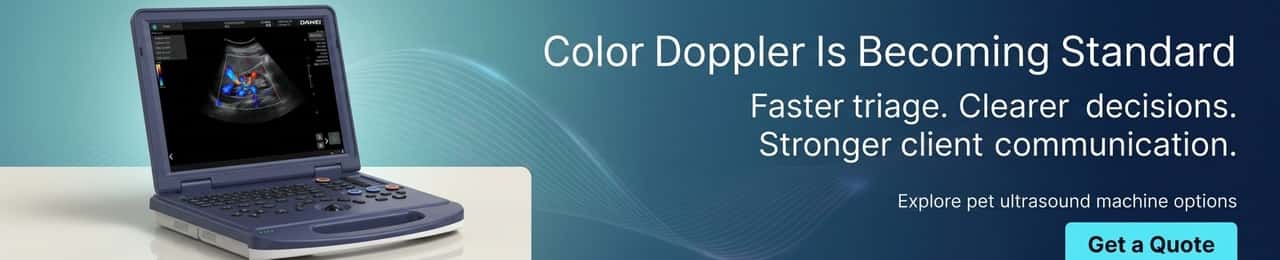
Veterinary Color Doppler used to be a “nice-to-have” feature—something reserved for larger hospitals, specialty practices, or referral centers with heavier caseloads.
That era is ending.
Across everyday pet clinics, Color Doppler veterinary ultrasound is rapidly becoming the default expectation: for better diagnostic confidence, faster triage, clearer client communication, and more consistent outcomes. Some clinics adopt it for cardiology; others for tricky abdominal cases; many for both. And once a team gets used to Doppler-assisted scanning, going back feels like turning the lights down.
If you’re building (or upgrading) your imaging workflow, you’ll want to understand why the shift is happening—and how to choose systems that fit real-world clinic work.
What is Color Doppler (in plain terms)?
B‑mode ultrasound shows anatomy. It’s the grayscale “map.”
Color Doppler adds movement information—primarily blood flow direction and relative velocity—layered onto that map. When paired with PW (pulsed-wave) spectral Doppler, you can quantify flow patterns rather than simply seeing them.
In practice, Doppler doesn’t replace B‑mode; it upgrades it. It turns many “maybe” cases into “yes/no” answers.
Why Color Doppler is becoming standard in pet clinics
1) Pet clinics see more complex cases than ever
Pet owners expect a higher level of care—sometimes immediately, often with limited patience for “wait and see.”
That pressure reshapes diagnostics.
Clinics that previously managed with basic B‑mode now encounter more cardiac murmurs, aging-related vascular changes, oncology suspicion, and complicated GI presentations. Doppler can reduce uncertainty in those gray-zone moments.
2) Faster triage, better decisions
Some exams are straightforward.
Others are not.
Color Doppler often saves time by answering a simple question early: Is there meaningful perfusion here? Is there a vessel where I think there’s a vessel? Is this structure vascular or avascular? Those answers guide the next step—treat, refer, monitor, aspirate, or do nothing.
3) More credible reporting and client communication
A good Doppler clip is persuasive.
Owners may not understand “echogenicity” or “border definition,” but they understand blood flow. It helps align expectations and supports compliance—especially when recommending referral, surgery, or a longer treatment plan.
4) Equipment accessibility: the price/performance gap is shrinking
Portable systems have improved dramatically.
Laptop-style units now combine Doppler performance, preset workflows, and export/report capability in a footprint that works for general practice. And for clinics that want maximum mobility, wireless probes are no longer a novelty—they’re a category.
If you want a quick overview of current options, see our category page:
- Pet ultrasound machine lineup (wireless, portable, laptop-style, cart):
Where Color Doppler adds the most value (everyday clinic scenarios)
Cardiac screening and murmur workups
Not every clinic runs full cardiology protocols.
Still, Color Doppler + PW Doppler can help you screen, document, and decide when referral is justified. The goal isn’t to replace the specialist; it’s to avoid missing signals—and to improve triage accuracy.
Abdominal and urinary exams
Vascularity patterns can help differentiate lesions, interpret organ perfusion, and avoid misidentifying vessels.
It’s subtle sometimes.
But in the messy cases—the ones that burn time and confidence—Doppler is often the difference between “I think” and “I’m sure.”
Reproductive imaging (when relevant)
Many practices do pregnancy confirmation and monitoring.
Doppler can support higher-confidence assessments in certain cases, depending on species, gestational stage, and protocol.
Choosing a Color Doppler system for pet clinics (a buyer’s checklist)
1) Don’t buy Doppler without PW Doppler
Color Doppler alone is useful, but Color + PW spectral Doppler is where the clinical value becomes durable. If you anticipate cardiac screening, vascular checks, or more advanced workflows, prioritize PW.
2) Probe strategy matters more than marketing
For dogs and cats, micro-convex probes are often the daily driver. Linear probes matter too—for superficial structures and small parts.
If your probe options don’t match your case mix, the “best” machine becomes a frustrating one.
3) Presets and workflow tools aren’t fluff
Time is expensive.
A system that boots quickly, recalls presets reliably, and exports images cleanly can outperform a higher-spec system that slows your daily routine.
4) Portability: match the device to your rooms and habits
- Wireless probes: fastest grab-and-go; great for quick checks.
- Laptop-style units: balanced performance + workflow.
- Cart systems: ideal for high-throughput rooms, multi-probe setups, and consistent scanning stations.
Today’s veterinary imaging market offers a wide range of options for both small animals and large animals—from dog ultrasound machines to cattle pregnancy scanners, and from basic black-and-white ultrasound systems to advanced color Doppler platforms. Models are plentiful, features often overlap, and spec sheets can look deceptively similar.
That’s exactly why the “right choice” is rarely just about picking a device. It’s also about choosing a manufacturer you can rely on long after the shipment arrives.
At DAWEI, we’ve supported veterinary clinics, distributors, and farms across 200+ export countries and regions, backed by 20+ years of global market experience. In many countries we work with local agents who can provide localized after-sales service and maintenance, and for day-to-day use we also offer online 1‑on‑1 support—so your team can get help with setup, scanning workflow, and troubleshooting without delays.
If you’re comparing options for a dog ultrasound machine or researching solutions for a cow ultrasound machine, the best next step is to shortlist models based on your exam types—and then choose a supplier that can support you locally and remotely for the long run.
FAQ: Color Doppler in pet clinics
Is Color Doppler necessary for every pet clinic?
Not always. But for clinics that see cardiac murmurs, older patients, oncology suspicion, or complex abdominal cases, it increasingly becomes the most efficient upgrade.
What’s the difference between Color Doppler and Power Doppler?
Color Doppler emphasizes direction/velocity patterns; Power Doppler emphasizes sensitivity to flow (often useful for lower-flow visualization). The best option depends on your exam types.
Can a portable system really deliver “clinic-grade” Doppler?
Many can—if the probe selection, presets, and signal processing match your workflow. That’s why comparing models as a set is often smarter than obsessing over one spec line.
Post time: Apr-28-2026