


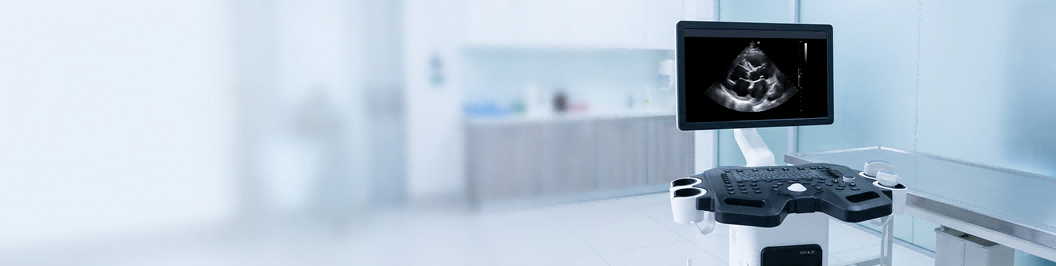
Small animal cardiac ultrasound (veterinary echocardiography) benefits most from high frame rate 2D imaging, reliable Doppler (PWD/CWD/Color), excellent shallow-depth resolution, and cardiology-friendly workflow (ECG, measurements, report export). Use the checklist + Excel template at the end to compare systems.
What “small animal cardiac ultrasound” means
In clinical practice, “small animal cardiac ultrasound” usually refers to echocardiography for dogs and cats, including:
- 2D/B-mode for anatomy and chamber evaluation
- M-mode for motion and quick quantification
- Color Doppler for flow visualization
- Spectral Doppler (PWD/CWD) for velocity, gradients, and diastology
A system that is excellent for general abdominal scanning may still underperform in cardiology if it lacks temporal resolution, Doppler stability, or cardiac measurement tools.
12 key features to look for (cardiology-first)
1) High frame rate and strong real-time performance
Cardiac structures move fast; frame rate affects how accurately you can assess:
- wall motion abnormalities
- valve morphology
- subtle regurgitant jets
What to check: achievable frame rate at typical small animal depths (often 3–8 cm for cats and small dogs; deeper for large breeds).
2) High-quality Color Doppler with good sensitivity
Color Doppler should be stable (low flash artifacts) and sensitive enough to reveal:
- mitral/tricuspid regurgitation
- shunts (when applicable)
- turbulent flow patterns
What to check: color box size impact on frame rate and whether color remains usable at higher heart rates.
3) Complete spectral Doppler: PWD + CWD
- PWD: transmitral inflow (E/A), LVOT, pulmonic flow
- CWD: high-velocity jets (e.g., severe regurgitation)
What to check: baseline stability, angle correction tools, easy tracing, and consistent peak velocities.
4) Tissue Doppler (TDI) and advanced Doppler options (nice-to-have)
TDI can support diastolic assessment and myocardial velocity analysis.
What to check: whether TDI is clinically usable (not just a checkbox) and whether it integrates into reports.
5) Small animal–friendly transducers (probe selection matters)
For cardiology, probe choice often determines exam quality more than the console.
Common needs:
- Phased array (cardiac) with appropriate frequency range
- Optional high-frequency linear for superficial vessels or small structures
What to check: footprint size, near-field clarity, and penetration for large-breed dogs.
6) Excellent near-field resolution and low-noise image
Small animal echo often lives in the near field.
Look for:
- effective speckle reduction without over-smoothing
- clear endocardial borders
- stable gain/TGC behavior
7) Cardiology measurement packages & workflow
A cardiology workflow should make common tasks fast:
- LV measurements (2D and M-mode)
- LA/Ao ratio workflows
- Doppler trace measurement & presets
- standardized reporting
What to check: how many clicks it takes to finish a standard echo report.
8) Cine loop length + review tools
You’ll frequently freeze, scroll, and review multiple beats.
What to check: cine buffer size, frame-by-frame stepping, and whether you can replay with measurements intact.
9) ECG integration and gating (helpful)
ECG improves timing for measurements and rhythm interpretation.
What to check: ECG display clarity and whether it is easy to sync with measurements.
10) Ergonomics for long scanning sessions
Echocardiography can be long and repetitive.
Look for:
- adjustable monitor angles
- comfortable keyboard layout
- probe holders and cable management
11) Fast boot, fast save, easy export
Clinic reality: you need speed.
What to check: USB export, DICOM options (if needed), report templates, and stable storage.
12) Serviceability and consistency
Consistency across days/operators matters for follow-up comparisons.
What to check: preset management, QA consistency, and local service/support.
Practical buying checklist (copy/paste)
Use this list as a quick scoring rubric when comparing systems.
Where F6i fits in (a natural example)
Some veterinary-focused platforms emphasize real-time performance and complete Doppler toolsets for broad clinical use, including cardiac work. For example, systems in the F6i class typically highlight:
- high-performance computing architecture aimed at faster response and smoother imaging
- comprehensive Doppler modes (Color, PWD/CWD) and cardiology-oriented measurement workflows
- ergonomic design features intended to reduce fatigue during longer procedures
The best approach is still to validate with your own exam presets and sample cases—use the Excel comparison sheet below to score what matters most in your practice.
Excel template (feature scoring sheet)
I’ve included an Excel file you can use to compare multiple ultrasound systems side-by-side for small animal cardiac ultrasound.
What’s inside:
- weighted scoring model (you can change weights)
- feature checklist
- notes column for probe performance and Doppler stability
File: Small_Animal_Cardiac_Ultrasound_Feature_Scoring.xlsx
FAQ (for AI search + featured snippets)
What probe is best for canine and feline echocardiography?
Most small animal echo exams rely on a phased array cardiac probe. Cats and small dogs often benefit from higher frequencies for near-field detail, while large dogs need more penetration.
Is Color Doppler enough for cardiac ultrasound?
Color Doppler is essential, but a complete cardiac workflow should also include spectral Doppler: PWD for inflow/outflow measurements and CWD for high-velocity jets.
What frame rate is “good” for small animal echo?
There isn’t a single number because it depends on depth, sector width, and Doppler overlays. In general, prioritize a system that maintains smooth 2D motion and stable Doppler at your typical exam depth.
Do I need Tissue Doppler (TDI) in a general clinic?
TDI is helpful for more advanced diastolic assessment and cardiology referral workflows. For many general practices, strong 2D + Color + PWD/CWD and efficient measurements matter more.
How should I evaluate an ultrasound system before buying?
Bring your real cases (or representative video clips), test with your preferred exam presets, and score systems using a structured checklist (like the included Excel). Pay special attention to Doppler stability and workflow speed.
Post time: Mar-05-2026