



Portable veterinary ultrasound machines can cost anywhere from a few hundred dollars to more than $10,000. That’s a wide range, especially when many of the machines look quite similar at first glance.
The difference becomes clearer when you look at how they’re built and what they’re designed to do.
A handheld scanner for pregnancy checks on a farm doesn’t need the same imaging functions as a Color Doppler system used to examine abdominal organs, blood vessels, or cardiac structures. The type of probe, screen size, image-processing technology, and software can all make a difference to the final price.
At Dawei Veterinary Medical, our portable veterinary ultrasound range starts at approximately $400 for the Elite handheld scanner. Laptop-style Color Doppler systems such as the L30i and L3 cost around $2,700–$3,500, while higher-specification portable models like the P8 can reach $12,000.
If you’re comparing veterinary ultrasound equipment for your clinic, farm, or animal hospital, here’s what you can expect at each price level.
1. Portable Veterinary Ultrasound Prices in 2026
The table below shows reference prices for seven Dawei veterinary ultrasound models.
| Model | Type | Reference Price (USD) |
|---|---|---|
| Dawei Elite | Handheld B/W ultrasound | $500–$700 |
| Dawei Slite | Handheld B/W ultrasound | $700–$1,800 |
| Dawei Y6 | Handheld B/W ultrasound | $1,500–$2,200 |
| Dawei L30i-VET | Laptop-style Color Doppler | $2,700–$3,500 |
| Dawei L3-VET | Laptop-style Color Doppler | $3,200–$3,500 |
| Dawei P60-VET | Portable Color Doppler | $4,500–$6,500 |
| Dawei P8-VET | Portable Color Doppler | $8,500–$12,000 |
Prices are approximate manufacturer reference ranges in USD. The final quotation depends on the selected transducers, equipment configuration, and accessories. Shipping, customs duties, and applicable taxes are quoted separately unless otherwise specified.
One thing worth pointing out is that all seven systems can serve veterinary applications involving different animal species. A machine isn’t necessarily limited to cattle because it’s commonly used on farms, or limited to dogs and cats because it appears in a pet clinic.
The available transducers and examination functions are what determine whether a particular setup is suitable.
2. Handheld Veterinary Ultrasound Machines: $500–$2,200
Handheld ultrasound is particularly useful when examinations take place outside a dedicated imaging room.
Veterinarians working with livestock often need equipment they can carry between animals without a trolley or external power supply. Smaller scanners can also be useful for basic examinations in clinics and breeding facilities.
Dawei offers three handheld models at different price levels: Elite, Slite, and Y6.
Dawei Elite: $500–$700
The Elite is the most affordable model in this comparison.
It uses mechanical sector scanning and has a 5.6-inch LED display. The system supports B, B+B, 4B, BM, and M display modes, along with basic measurement functions and cine playback.
The main unit weighs approximately 850g, making it practical to carry between examination areas.
Its standard 2600mAh rechargeable battery provides approximately three hours of operation under typical conditions. A larger 5200mAh battery is available as an option.
For a sheep breeder checking pregnancy or a veterinarian carrying out routine reproductive examinations, this kind of straightforward setup may be all that’s required.
The Elite also includes image storage and USB export, so examination images can be saved and reviewed.
At $400–$700, it offers an accessible starting point for buyers who need a basic veterinary scanner without Color Doppler imaging.
Dawei Slite: $700–$1,800
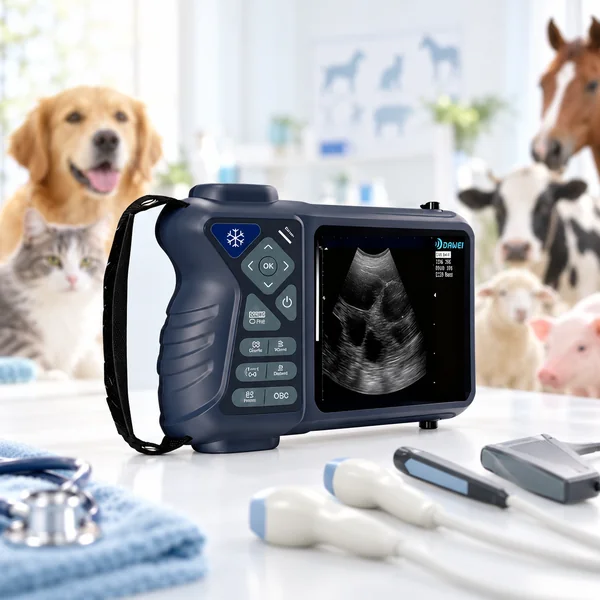
The Slite Livestock Ultrasound Machine is worth considering when you need more choice in transducer configurations.
It features a 5.6-inch color LED display and supports B, B+B, 4B, BM, and M imaging modes.
Depending on the selected probe, the Slite can be used for examinations involving cattle, horses, sheep, pigs, dogs, cats, and other animals.
For example, a rectal probe may be selected for cattle reproductive examinations, while a microconvex probe is often more appropriate for abdominal scanning in smaller animals.
This flexibility can be useful for veterinarians working with several animal species rather than focusing on one type of livestock.
The Slite is also designed for fieldwork, with a rechargeable battery, protective construction, and portable carrying options.
Because different probe combinations are available, its price range is relatively broad: $700–$1,800.
When comparing Slite quotations, ask which probe is included. The difference between two packages may have more to do with the transducer configuration than the scanner itself.
Dawei Y6 Equine Ultrasound Machine: $1,500–$2,200
If you regularly perform ultrasound examinations on farms, the Y6 offers several practical features worth considering.
It has an 8-inch color LED display, larger than the screens found on the Elite and Slite.
That extra viewing area can be helpful when checking images during examinations, particularly when you need to work away from a conventional clinical workstation.
The Y6 also has a 6600mAh rechargeable battery, 256-level grayscale imaging, electronic focusing adjustments, and a waterproof body designed for field conditions.
Its available transducers include rectal, convex, microconvex, linear, and backfat probe options, depending on the configuration.
This means the Y6 can support more than pregnancy checks in cattle and sheep. With suitable probes, it can also be considered for abdominal, reproductive, and selected superficial examinations in other animals.
At $1,500–$2,200, the Y6 costs more than the other handheld models discussed here.
For veterinarians who scan frequently and value the larger display, battery capacity, and field-oriented construction, those differences may justify the additional expense.
3. Laptop-Style Veterinary Ultrasound Machines: $2,700–$3,500
There comes a point when a handheld scanner may no longer meet all the needs of a veterinary practice.
For example, you may need to examine internal organs in greater detail, assess blood flow, save examination records, or switch between different probes throughout the day.
This is where laptop-style Color Doppler ultrasound systems become useful.
Dawei’s L30i-VET and L3-VET offer these capabilities in portable designs.
Dawei L30i-VET: $2,700–$3,500
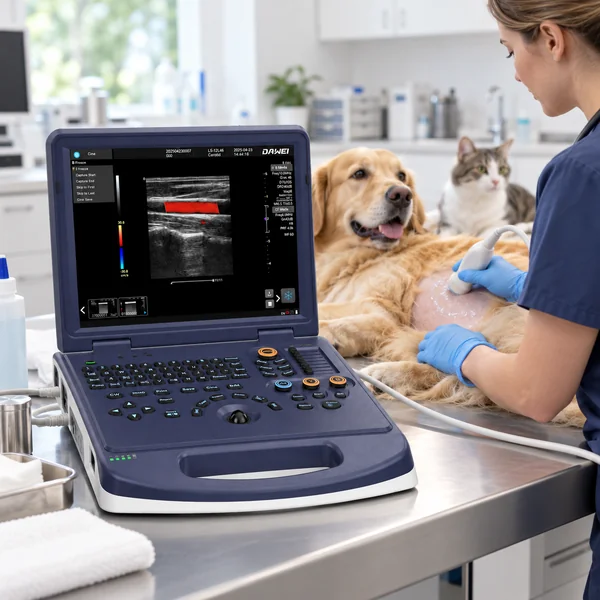
The L30i-VET is a portable Color Doppler ultrasound system with a 15-inch-class display and several imaging modes for veterinary examinations.
It supports Color Doppler, Pulsed Wave (PW) Doppler, Directional Power Doppler, Tissue Harmonic Imaging (THI), and spatial compound imaging.
These functions allow veterinarians to examine anatomical structures and obtain blood-flow information when needed.
For instance, a veterinarian examining a dog’s liver may begin with B-mode imaging to assess the organ’s appearance and then use Doppler imaging to investigate relevant blood vessels.
The L30i also offers several probe options.
Its R11 microconvex probe operates across a 4.0–8.0 MHz frequency range and is useful for cats, smaller dogs, and examinations where the available scanning window is limited.
A convex probe can be selected for deeper abdominal examinations, while a 6.0–12.0 MHz linear probe is available for superficial structures such as tendons, lymph nodes, and small organs.
Beyond imaging, the L30i includes a 128GB-class SSD, image and cine review, examination report templates, and DICOM 3.0 connectivity.
These details can be useful in clinics that need to keep patient records and share images as part of their diagnostic workflow.
With prices ranging from $2,700 to $3,500, the L30i is one option for veterinary practices looking for a portable Color Doppler system without moving to a larger workstation.
Dawei L3-VET: $3,200–$3,500
The L3-VET is another laptop-style Color Doppler system in a similar price range.
Like the L30i, it has a 15-inch display and supports Color Doppler and PW Doppler imaging.
It also includes Tissue Harmonic Imaging, compound imaging, trapezoidal imaging, and one-key image optimization.
The L3 supports real-time combined B-mode, Color Doppler, and spectral imaging, which can help veterinarians review anatomy and blood-flow information during an examination.
It provides 128GB of internal storage, cine playback of at least 600 frames, and DICOM 3.0 connectivity for compatible image-management systems.
With appropriate probes, it can be used for examinations involving dogs, cats, sheep, reptiles, and other animals.
This makes it relevant not only to veterinary clinics but also to zoos, breeding facilities, and animal research institutions.
L30i or L3: Which Should You Choose?
With the two systems priced so closely, the decision shouldn’t depend on price alone.
Both offer Color Doppler imaging, a 15-inch-class display, and examination data management.
It’s worth comparing the exact transducer packages, imaging controls, and clinical demonstrations for the animals you examine most often.
If possible, request sample images from the same types of examinations. That will tell you more than comparing a few specifications on paper.
4. Higher-Specification Portable Color Doppler: $4,500–$12,000
Portable ultrasound doesn’t always mean a basic or lightweight device.
Some portable systems are designed for more detailed diagnostic work, with multiple probe connections, additional imaging functions, and larger storage capacity.
Dawei’s P60-VET and P8-VET fall into this category.
Dawei P60-VET: $4,500–$6,500
The P60-VET is a portable Color Doppler ultrasound system with a 15-inch display and at least two probe connections.
It supports conventional ultrasound imaging and a range of Doppler examination functions.
The technical specifications also list Tissue Doppler Imaging (TDI), along with additional imaging technologies and optional functions such as panoramic imaging.
These capabilities may be relevant to veterinarians who regularly examine abdominal organs, blood vessels, or cardiac structures.
The P60 is not limited to dogs and cats. Its applications also extend to animal research and selected examinations involving other species.
For example, Dawei has documented ultrasound applications involving fish reproductive assessment, as well as imaging of small laboratory animals.
For a veterinary hospital, research institution, or clinic handling more specialized examinations, the P60 may be worth comparing with less expensive portable systems.
At $4,500–$6,500, buyers should review the included functions and probe options carefully, particularly where advanced imaging packages are concerned.
Dawei P8-VET: $8,500–$12,000
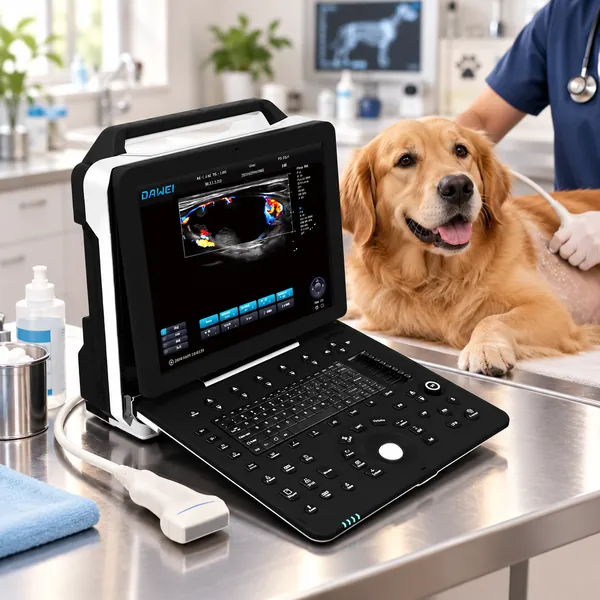
The P8-VET is the highest-priced model in this comparison.
It features a 15-inch high-resolution display, at least two activated probe ports, a built-in ultrasound workstation, and at least 256GB of storage.
The system supports multiple Doppler imaging modes and provides cine playback of more than 3,000 frames.
These features can be useful when examinations require detailed image review or when a clinic performs many scans throughout the day.
The P8 supports a broad range of veterinary applications.
In dogs and cats, it can be used for abdominal, urinary, reproductive, and selected cardiac examinations with compatible transducers and software.
For horses, potential applications include reproductive examinations and tendon or ligament imaging.
With appropriate probe configurations, it can also support examinations in cattle, sheep, pigs, and other animals.
The P8′s higher price doesn’t mean every veterinarian needs one.
A clinic carrying out a handful of routine examinations each week may find a simpler system perfectly adequate.
For hospitals or institutions where ultrasound is used extensively and image-management requirements are more demanding, a higher-specification system may be a reasonable investment.
5. Why Can Two Portable Veterinary Ultrasound Machines Have Such Different Prices?
The $400 Elite and the $12,000 P8 are both portable veterinary ultrasound systems, but they are built for different levels of clinical work.
The price difference comes down to several practical factors.
Imaging Technology
Basic B-mode ultrasound is commonly used for anatomical examinations and pregnancy checks.
Color Doppler adds information about the presence and direction of blood flow, while spectral Doppler allows further evaluation of flow velocities.
More comprehensive systems may also offer harmonic imaging, spatial compound imaging, and specialized imaging functions.
These technologies contribute to the equipment’s capabilities and overall cost.
Probe Selection
Probe configuration is another major factor.
For example, a linear rectal probe used during cattle breeding examinations is very different from a microconvex probe used to scan a cat’s abdomen.
A clinic treating several animal species may need multiple transducers, and those additional probes can increase the purchase price.
Display and Workflow
A 5.6-inch handheld scanner is easy to carry around a farm, while a 15-inch laptop-style ultrasound offers more viewing space and a different set of controls.
For busy clinics, image storage, report templates, DICOM compatibility, and convenient probe switching can also matter.
Software and Data Management
Some practices simply need to scan an animal and review the image immediately.
Others need to store patient histories, export examination images, prepare reports, or share imaging data across departments.
These workflow requirements can influence the type of ultrasound system worth purchasing.
6. Choosing a Portable Ultrasound for Different Animals
One of the most important things to understand is that veterinary ultrasound machines are not always designed for just one animal species.
The same system may be used for cattle, horses, sheep, dogs, or cats, provided it has the appropriate transducer and examination settings.
The better question is: What are you trying to examine?
| Examination | Common Probe Choice | What to Consider |
|---|---|---|
| Cattle pregnancy examination | Rectal linear or rectal convex | Probe access, field operation, portability |
| Sheep and goat pregnancy checks | Convex or suitable reproductive probe | Imaging depth, animal size, field workflow |
| Dog and cat abdominal ultrasound | Microconvex or convex | Patient size, image detail, scanning depth |
| Tendon and superficial structures | Linear | Higher-frequency imaging and anatomical detail |
| Cardiac ultrasound | Phased-array | Cardiac software, Doppler and measurement functions |
| Research and exotic-animal imaging | Application-specific probe | Animal size, protocol and imaging requirements |
For mixed-animal veterinary practices, probe flexibility may be more valuable than choosing a machine based solely on its advertised animal category.
A veterinarian treating both livestock and companion animals should confirm that the required probes and examination packages are supported by the selected model.
7. What Else Should You Budget For?
The price of the main ultrasound unit is only part of the purchase.
Before comparing quotations, check what comes in the package.
Does the price include a probe? Is an additional transducer required? Are the battery, carrying case, and examination software included?
For laptop-style and higher-specification systems, ask about image-management functions, accessories, and optional imaging packages.
International buyers should also consider shipping charges, import duties, and local taxes.
Two quotations that appear similar may include different accessories or delivery terms.
For that reason, it’s usually better to compare complete configurations rather than the price of the main unit alone.
8. Frequently Asked Questions
How much does a handheld veterinary ultrasound cost?
Within Dawei’s range, handheld ultrasound prices start at approximately $400–$700 for Elite. Slite costs around $700–$1,800, while Y6 ranges from $1,500–$2,200, depending on the configuration.
How much does a portable Color Doppler veterinary ultrasound cost?
Dawei’s L30i-VET starts at approximately $2,700, while higher-specification portable Color Doppler systems such as P60 and P8 range from $4,500 to $12,000.
Can the same veterinary ultrasound machine be used for cattle, sheep, dogs, and cats?
Many veterinary ultrasound systems support different animal species when configured with suitable probes and examination settings.
The exact applications depend on the model, transducer compatibility, and diagnostic functions.
What type of ultrasound probe is used for cattle pregnancy diagnosis?
Rectal linear and rectal convex probes are commonly used for cattle reproductive examinations. The choice depends on the examination technique, scanning depth, and ultrasound system.
Is a handheld ultrasound suitable for a veterinary clinic?
It can be suitable for certain examinations, especially where portability is important. However, clinics performing more detailed abdominal, vascular, or cardiac examinations may require additional imaging functions.
Why is the Dawei P8 more expensive than the L30i?
The P8 is positioned as a higher-specification portable system, with multiple activated probe ports, larger internal storage, and expanded examination workflow features.
Whether those differences justify the cost depends on the clinic’s examination volume and imaging requirements.
Does the listed price include shipping and probes?
Not necessarily. Probe selection, accessories, delivery charges, and import costs should be confirmed in the final quotation.
9. Final Thoughts
Buying a portable veterinary ultrasound machine isn’t just about choosing between a $700 scanner and a $7,000 system.
It’s about understanding what your daily examinations require.
For routine reproductive work on farms, a compact handheld scanner may be the most convenient and economical option.
For veterinary clinics that regularly examine internal organs or assess blood flow, a laptop-style Color Doppler system may provide more useful functions.
Larger veterinary hospitals, research facilities, and practices with specialized imaging needs may find additional value in systems such as the P60 or P8.
Dawei Veterinary Medical manufactures handheld, laptop-style, and portable Color Doppler ultrasound machines for a wide range of animal applications.
If you’re comparing models, tell us which animals you work with and what examinations you need to perform. We can help you review suitable probes, equipment configurations, and reference pricing before you make a decision.
For an overview that also includes cart-based systems, see our guide: How Much Does a Veterinary Ultrasound Machine Cost?
Post time: Oct-13-2026