


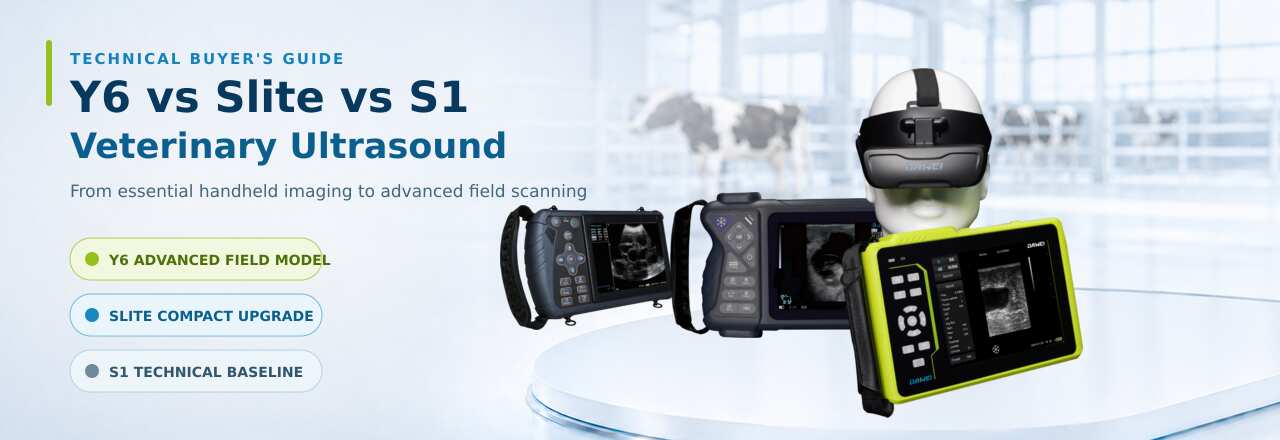
Y6 vs Slite vs S1 Veterinary Ultrasound: A Technical Comparison for Field Scanning
Quick answer. S1 is the core handheld platform for routine abdominal and reproductive scanning. Slite is the practical upgrade from S1, adding a 5200mAh battery configuration, USB-disk storage support, front-panel waterproofing and a cabled goggle workflow while retaining a 5.6-inch handheld format. Y6 is the stronger field model, with an 8-inch display, 6600mAh battery, whole-body waterproof construction, a 128-crystal probe head in the compared configuration and wireless support for multiple goggles.
Portable veterinary ultrasound machines often look similar on a product page. In use, however, a larger screen, stronger enclosure protection, a different storage route or a few extra hours of battery capacity can change the entire working rhythm. A veterinarian scanning cows in a wet barn does not evaluate equipment in the same way as a breeder performing scheduled pregnancy checks, and neither works under the same conditions as a mobile mixed-animal practice.
That is why this comparison stays close to the supplied technical documents. It does not rank the three systems by price or marketing language. Instead, it asks a more useful question: which specification set best matches the examination, animal, environment and daily workload?
The Three-Model Positioning in One Minute
Choose S1 when you need a proven 5.6-inch handheld B/W ultrasound for routine abdominal exams, pregnancy work and multi-species use, with a 2600mAh battery and 32G storage.
Choose Slite when you want to step up from S1 without leaving the compact 5.6-inch form factor. Its main gains are power reserve, USB-disk support, specified front-panel waterproofing and goggle-assisted viewing.
Choose Y6 when field durability and visibility take priority. Its 8-inch display, 6600mAh battery, whole-body waterproof design and wireless multi-goggle workflow put it at the top of this three-model field hierarchy.
Technical Specification Comparison: S1 vs Slite vs Y6
| Parameter | S1 | Slite | Y6 |
| Product role | Core handheld platform | Compact upgrade from S1 | Advanced field-oriented model |
| Main monitor | 5.6-inch LED medical display | 5.6-inch high-resolution color LED | 8-inch high-resolution color LED |
| Battery | 2600mAh; more than 3 hours | 5200mAh | 6600mAh |
| Probe-head crystals* | 80 elements | 80 | 128 |
| Water protection | Front panel waterproof; silicone case | Front panel waterproof; silicone case | Whole body waterproof; soft rubber stopper; splash-proof and dust-proof |
| Storage | 32G readable/recordable | 32G permanent + USB disk | 32G permanent + TF card |
| Cine loop | 255 frames | 256 frames | 256 frames |
| Display modes | B, 2B, 4B, B/M, M | B, BB, 4B, BM, M | B, BB, 4B, BM, M |
| System languages | Chinese, English, French, Russian, Spanish, Portuguese | Chinese, English, French, Russian, Spanish, Portuguese | Chinese, English |
| Electronic focus | Four sections; adjustable focus position | Four sections; adjustable focus position | Four-zone electronic focus; adjustable focus position |
| Gray scale | 256 levels | 256 levels | 256 levels |
| Pseudo colors | 24 | 24 | 28 |
| Backfat measurement | Automatic and manual modes | Automatic calculation | Automatic calculation |
| Grid | Two grid spacings; 15 grid colors | Line grid and point grid | Line grid and point grid |
| Goggles | Cabled; one goggle | Cabled; one goggle | Wireless; supports multiple goggles |
| Sunshine cover | Not stated | Soft | Hard |
| Carrying / use | Shoulder straps | Handheld, chest, back or waist hanging | Handheld, chest, back or waist hanging |
| Case | Aluminum suitcase | Black plastic suitcase | Suitcase |
| Rectal probe introducer | Supported | Supported | Supported |
| Standard probe | 6.5MHz linear rectal probe | 6.5MHz linear rectal probe | 6.5MHz linear rectal probe |
| Optional probe highlights | 3.5MHz convex; 5.0MHz micro-convex; 6.5MHz rectal linear; 6.5MHz sheep rectal; 7.5MHz linear; 3.5MHz backfat | 4.0MHz rectal convex; 6.5MHz micro-convex; 3.5MHz convex; 7.5MHz linear; 3.5MHz backfat | 4.0MHz rectal convex; 5.0MHz micro-convex; 3.5MHz convex; 7.5MHz linear; 3.5MHz backfat |
| Animals listed | Cattle, horses, dogs, cats, sheep and pigs | Bovine, equine, ovine, canine, feline, goat, swine, llama and others | Bovine, equine, ovine, canine, feline, goat, swine, llama and others |
*Probe-head crystal counts are stated in the supplied Y6/Slite comparison for the compared probe configuration. Confirm the exact probe specification when ordering.
Why Slite Is the Upgrade from S1
The upgrade story is not that Slite abandons the S1 concept. It improves the same concept. Both are 5.6-inch handheld veterinary ultrasound systems built for work close to the animal, where one-handed control and fast deployment matter. The difference is that Slite addresses several practical limitations that become noticeable during longer field days.
1. Twice the listed battery capacity
The S1 technical sheet specifies a 2600mAh rechargeable battery and more than three hours of operation. The Slite comparison configuration lists 5200mAh. Capacity alone does not guarantee an exact doubling of runtime, because power consumption varies with display brightness, probe use and battery condition. Still, the specification gives Slite substantially more energy reserve for farm calls, pregnancy-checking sessions and locations where charging is inconvenient.
2. A more flexible storage and transfer path
S1 provides 32G readable and recordable storage. Slite keeps 32G permanent storage and adds USB-disk support in the supplied comparison. That matters when images must move from the scanner to a computer, a customer record or a remote consultation workflow without waiting until the end of the day.
3. Better-specified protection for field use
The S1 sheet does not state a waterproof classification. Slite explicitly specifies front-panel waterproofing and a silicone case. This should not be interpreted as whole-device waterproofing, but it is a meaningful upgrade in the areas most exposed to handling, splashes and routine field contact. If cleaning by rinsing is a requirement, Y6 is the stronger choice because its supplied sheet describes whole-body waterproof construction.
4. An added wearable viewing workflow
Slite supports one cabled goggle. For transrectal examinations, this can help the operator maintain a more natural line of sight while keeping attention on the animal and probe position. S1′s technical sheet does not list a goggle option. Y6 extends the concept further with wireless goggles and support for multiple viewers.
5. Familiar operation, fewer reasons to retrain
S1 and Slite share the essential B-mode family used in routine livestock imaging, and both support convex, linear, rectal and backfat-oriented probe configurations. The upgrade therefore remains operationally familiar. Buyers can improve endurance and field workflow without moving to a completely different category of ultrasound system.
What Slite keeps from the S1 technical baseline
S1 is not a stripped-down scanner. Its supplied parameter sheet specifies four-section electronic focus, 256 gray levels, 24 pseudo colors, 32G storage, a 255-frame cine loop, one-click parameter reset, automatic and manual backfat measurement, and species-specific obstetric packages. Slite should therefore be presented as a workflow and field-use upgrade – especially in battery capacity, external storage, protection and goggle use – rather than as an implication that S1 lacks core imaging functions.
Bottom line: Slite is the logical S1 upgrade for buyers who want the same compact handheld class with greater listed battery capacity, easier external storage, specified front-panel protection and goggle-assisted scanning.
Where Y6 Moves Beyond Slite
Y6 is not simply a larger Slite. Its technical advantages concentrate on visibility, enclosure protection, probe-head specification and shared viewing – the details that become decisive in demanding cattle and equine work.
Larger 8-inch viewing area
Y6 increases the display from Slite’s 5.6 inches to 8 inches. In bright barns, crowded crush areas or examinations where the operator stands farther from the unit, the larger image can make anatomy and measurement markers easier to review. Slite remains more compact; Y6 prioritizes viewing comfort.
Higher battery capacity for longer sessions
The supplied sheets list 6600mAh for Y6 and 5200mAh for Slite. The difference is particularly relevant for route-based work: multiple farms, large breeding groups or days when the scanner stays powered for repeated examinations. Actual runtime still depends on use conditions, so battery capacity should be treated as a technical comparison rather than a guaranteed shift length.
Whole-body waterproof construction
Slite specifies front-panel waterproofing. Y6 specifies whole-body waterproofing, plus a soft rubber stopper and splash- and dust-proof protection. No IP rating is stated in the comparison document, so the safest editorial claim is exactly that: whole-body waterproof construction as described by the supplied sheet, not submersion resistance.
128 crystals and wireless multi-goggle support
For the compared probe configuration, Y6 lists 128 crystals in the probe head versus 80 for Slite. Crystal count is one contributor to probe construction and should not be used as a stand-alone promise of image quality, yet it is a clear hardware distinction. Y6 also replaces Slite’s single cabled goggle with wireless support for multiple goggles, which can help during training, demonstration or team-based reproductive work.
Choosing by Veterinary Workflow
Choose S1 for essential routine scanning
S1 fits buyers who need a straightforward handheld B/W system for abdominal examinations and reproductive work across cattle, horses, sheep, pigs, dogs and cats. Its 5.6-inch display, 255-frame cine loop, 32G storage and broad optional probe list cover the core workload. It is also the clearest starting point when the buyer’s first concern is access to the main ultrasound functions rather than weather protection or wearable viewing.
Choose Slite for mobile mixed workloads
Slite is best understood as the middle of the range. It stays compact, yet it is better prepared for longer mobile work than S1. The 5200mAh battery, 32G plus USB-disk storage, 24 pseudo colors, front-panel waterproofing, rectal introducer support and cabled goggle make it a practical choice for breeders, farm veterinarians and mobile operators who scan different animals without needing Y6′s larger screen or full enclosure protection.
Choose Y6 for wet, dusty or high-throughput field environments
Y6 is the strongest specification fit when the machine will be used repeatedly in challenging farm conditions. The 8-inch display supports easier viewing; the 6600mAh battery increases working reserve; whole-body waterproof construction improves cleaning and exposure tolerance; and wireless multi-goggle support helps when more than one person needs to see the scan. Its hard sunshine cover and TF-card storage further reinforce the field-oriented setup.
Probe Selection Still Comes First
The machine is only half of an ultrasound configuration. The probe determines the acoustic window, access route and practical exam. Before choosing between S1, Slite and Y6, define the animals and examinations that generate most of the workload.
Cattle and equine reproduction: prioritize the rectal probe configuration. Slite and Y6 list a 6.5MHz linear rectal probe as standard in the supplied comparison; S1 offers rectal linear and other rectal options in its technical sheet.
General abdominal scanning: use the convex probe option for deeper structures and broader abdominal windows.
Small animals and restricted acoustic windows: use a micro-convex probe. The supplied lists specify 5.0MHz for S1 and Y6, and 6.5MHz for Slite.
Superficial tissue: consider the 7.5MHz linear probe option.
Swine production: select the 3.5MHz backfat and loin-muscle probe when production measurements are part of the workflow.
A model should never be selected from the main unit specification alone. Confirm the standard probe, optional probe model, intended species and final package before quotation.
A Five-Step Buying Checklist
List the animals you scan most often and separate routine abdominal exams from reproductive or backfat work.
Choose the probe route first: abdominal, superficial, transrectal or production measurement.
Estimate the longest work session away from power, then compare 2600mAh, 5200mAh and 6600mAh battery configurations.
Match enclosure protection to the real environment. ‘Front-panel waterproof’ and ‘whole-body waterproof’ are not equivalent claims.
Confirm the final quotation configuration, especially storage media, goggle type, probe frequency and included accessories.
Frequently Asked Questions
Is Slite an upgrade from S1?
Yes. In this three-model positioning, Slite is the practical upgrade from S1. It retains the 5.6-inch handheld format while increasing the listed battery capacity from 2600mAh to 5200mAh and adding USB-disk support, front-panel waterproofing and one cabled goggle. S1 remains the essential platform; Slite improves field endurance and workflow.
What is the main difference between Slite and Y6?
Y6 is built around stronger field specifications: an 8-inch screen instead of 5.6 inches, a 6600mAh battery instead of 5200mAh, whole-body waterproofing instead of front-panel waterproofing, 128 versus 80 probe-head crystals in the compared configuration, and wireless support for multiple goggles instead of one cabled goggle.
Which model is best for cattle pregnancy diagnosis?
All three can be configured for cattle reproductive work. S1 supports rectal probes; Slite and Y6 list a 6.5MHz linear rectal probe as standard in the supplied comparison. Choose S1 for essential work, Slite for longer compact field use, or Y6 when screen size, waterproof construction and higher battery capacity matter most.
Can these systems be used for horses, sheep and pigs?
Yes. The supplied documents list multi-species use. S1 covers cattle, horses, sheep, pigs, dogs and cats. The Y6/Slite comparison also lists bovine, equine, ovine, canine, feline, goat, swine, llama and other animals. The correct probe must be matched to the animal and examination.
Is Y6 waterproof?
The supplied comparison describes Y6 as whole-body waterproof, splash-proof and dust-proof, with a soft rubber stopper. It does not state an IP rating. Do not describe it as submersible unless a separate certified rating is provided.
Does a higher probe crystal count guarantee a better image?
No. The comparison lists 128 crystals for Y6 and 80 for Slite in the compared probe heads, but image quality also depends on probe design, frequency, beamforming, processing, scanning technique and the animal. Crystal count is a useful hardware distinction, not a stand-alone diagnostic promise.
Why do some specifications say ‘not stated’?
Because this article uses only the supplied technical parameter documents. When a feature is absent from a source sheet, the comparison marks it as not stated instead of assuming the feature is unavailable. Confirm any unlisted requirement with the final technical quotation.
Final Recommendation
The three systems form a clear progression. S1 supplies the essential handheld ultrasound functions. Slite is the sensible upgrade for users who want greater battery capacity, better field protection and a more flexible viewing and storage workflow without moving away from a compact 5.6-inch unit. Y6 is the premium field choice in this group, designed for buyers who value a larger display, higher battery capacity, whole-body waterproof construction and wireless multi-user viewing.
The best purchasing decision is therefore not ‘Which model has the most features?’ It is ‘Which specification solves the working conditions I face every week?’ Define the animals, probe route, session length, cleaning method and viewing needs. Then select the model and configuration that fits those facts.
Request a configuration-based quotation. Send your primary animal species, examination type, preferred probe, expected daily working time and field conditions. The Dawei team can then match S1, Slite or Y6 to the exact application and prepare the appropriate package.
Post time: Aug-18-2026