



Why ultrasound matters for small breeders
For small breeders, timing is everything: feed planning, re-breeding decisions, grouping by gestation stage, and reducing open days. A good ultrasound setup can help you:
- Confirm pregnancy earlier (vs. waiting for obvious physical signs)
- Identify non-pregnant animals sooner for re-breeding
- Improve herd/flock reproductive records
- Reduce unnecessary feed and housing costs for open females
- Make better culling decisions over time
The “best” machine isn’t the most expensive—it’s the one that fits your animals, your workflow, and your budget.
The 7 most important features in a breeder-friendly ultrasound machine
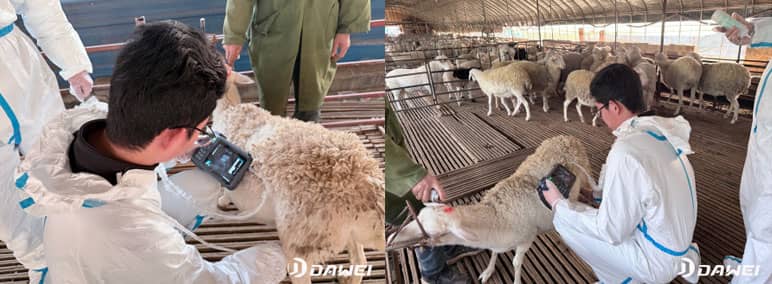
1) Image quality that stays stable in the field
Small breeders often scan in barns, pens, or outdoor handling areas. Look for stable B-mode imaging with practical image tuning controls (gain, depth, focus). Extra processing features are helpful, but consistency is more important than flashy specs.
What to look for
- Clear grayscale contrast (so fluid, tissue, and boundaries are easy to see)
- Adjustable depth and gain
- Multi-zone or adjustable focus for better near/far balance
2) The right probe for your species (this matters more than the brand)
Probe choice is usually the #1 factor that determines whether scanning feels easy or frustrating.
- Convex probe (around 3.5 MHz): Great general-purpose option for ruminants and pigs. Good penetration and a wider view—ideal for routine pregnancy checks and abdominal sweeps.
- Linear probe (higher frequency): Better for superficial structures and higher-resolution detail (tendons, superficial tissue, some small ruminant applications depending on depth).
- Rectal probe (optional): Most useful for cattle reproduction management (follicles/CL monitoring, early pregnancy, uterine evaluation).
- Micro-convex (optional): Helpful when you need a smaller footprint or tighter scanning windows.
If you’re a small breeder doing mostly pregnancy checks, a convex probe is often the best starting point.
3) Portability and one-handed operation
A small breeder typically doesn’t have a dedicated ultrasound room—or an assistant holding equipment. Choose a unit that’s truly portable and balanced in the hand.
Checklist
- Lightweight handheld body
- Comfortable grip
- Simple button layout (freeze, save, menu navigation)
- Easy screen visibility in barn lighting
4) Battery life (and whether you can swap batteries)
Battery life is a real productivity feature. If you scan multiple pens or multiple farms in a day, a swappable battery can be a game-changer.
Look for:
- Replaceable Li-ion battery design
- Realistic runtime for your scanning sessions
- Clear battery indicator
5) Fast image review and storage
Even small breeders benefit from saving images—especially if you want to track results, share with a vet, or audit your breeding program.
Useful functions include:
- On-device storage
- USB export
- Cine loop review (frame-by-frame helps confirm what you saw)
6) A screen you can actually read
Barns are not gentle environments. A bright, medical-grade display makes scanning much less stressful.
Look for:
- Mid-size screen that balances portability and visibility
- Good brightness and viewing angles
7) Simple measurements and reproductive templates
Breeders don’t need complex cardiology packages—but built-in measurements and common obstetric templates can reduce mistakes and speed up routine work.
Which “type” of ultrasound machine is best for a small breeder?
Option A: Handheld, livestock-focused ultrasound (best overall for most small breeders)
A livestock-focused handheld unit is usually the sweet spot: portable, durable, and tuned for reproductive/abdominal imaging. These systems are commonly used for:
- Sheep and goat pregnancy checking
- Pig pregnancy screening
- Cattle reproductive work (depending on probe choice)
If your main goal is pregnancy diagnosis and routine herd checks, this is typically the best fit.
Option B: Smartphone/tablet-based systems (best for ultra-light setups, but check durability)
Tablet-based ultrasound can be very portable. However, performance and durability vary widely, and some setups depend heavily on the app and device compatibility.
Option C: Clinic-style cart systems (best image potential, but usually overkill)
Cart systems can be excellent, but for a small breeder they’re often too expensive, too bulky, and not practical for barn-side scanning.
A practical shortlist: what to buy based on your animals
If you breed sheep/goats and do routine pregnancy checks
- Start with a handheld livestock ultrasound unit
- Choose a convex probe for general pregnancy work
- Prioritize battery life, bright screen, and quick freeze/save operation
- Convex probe + fast workflow matters most
- Cine review helps confirm scans quickly
- USB export is useful for record keeping
- Consider a rectal probe option
- Look for stable imaging and comfortable handling
- Built-in measurements/templates can improve repeatability
If you manage pigs and need fast screening
If you’re focused on cattle reproduction management
Where S-lite fits (a breeder-friendly example)
If you’re looking for a portable, livestock-oriented option, S-lite is positioned as a lightweight handheld system designed for field and mobile workflows.
Based on the published specifications and feature set, it emphasizes:
- A 5.6-inch medical-grade LED display for clearer viewing in barn or clinic settings
- Multi-language UI (software version dependent)
- 4-zone electronic focusing with adjustable focal position
- Built-in storage (4GB) + USB export for easy case sharing
- ≥256-frame cine review for frame-by-frame checking
- Swappable Li-ion battery (typical ~3 hours; optional higher capacity for longer runs)
- Common display modes (B, B+B, 4B, BM, M) and practical measurements
For readers comparing options, you can review the full feature overview and probe lineup on this page: livestock ultrasound machine (also useful if you’re specifically searching for a portable livestock ultrasound machine for barn-side work).
Tip for SEO + usability: if you’re building your own buyer guide page, using a descriptive anchor like “livestock ultrasound machine” or “veterinary pregnancy scanner” helps users understand what they’ll find after clicking.
How to choose the “best” ultrasound machine (quick decision framework)
Use this fast framework to narrow your choices in minutes:
- Pick your primary species (sheep/goat, pig, cattle, mixed)
- Choose the probe first (convex for general pregnancy checks; rectal for cattle reproduction work)
- Confirm field usability (weight, grip, screen brightness, one-handed controls)
- Check workflow features (cine review, storage, USB export)
- Validate battery strategy (runtime + swap capability)
- Ask about support (warranty, parts availability, probe options)
If two machines look similar, the best tie-breakers are usually: probe quality, after-sales support, and how quickly you can scan confidently.
FAQs: ultrasound for small breeders
How early can I detect pregnancy with ultrasound?
It depends on species, probe type, operator technique, and the animal’s condition. Many breeders use ultrasound for earlier confirmation than visual observation, but you should follow species-specific best practices and consult a veterinarian for protocols.
Is a higher MHz probe always better?
Not always. Higher frequency (MHz) typically improves detail but reduces penetration depth. For deeper structures (common in larger animals), a lower-frequency convex probe may perform better.
Do I need a “veterinary pregnancy scanner” or a general ultrasound machine?
A livestock- or veterinary-focused system is usually easier for reproductive work because the probes, presets, measurements, and durability match farm workflows.
What’s the best ultrasound machine for a small breeder on a budget?
Focus on value, not the cheapest unit: choose a reliable handheld device with the correct probe for your species, stable image quality, and practical workflow features (freeze/save, cine review, and easy export).
Bottom line
The best ultrasound machine for a small breeder is typically a portable livestock ultrasound machine with the right probe, stable imaging, and a workflow that fits real barn conditions. Start with your species and probe choice, then prioritize portability, battery strategy, and easy image review.
If you want a reference point for a handheld setup designed for breeding and mobile use, you can also explore this veterinary pregnancy scanner product page and compare the features to your checklist.
Post time: Feb-27-2026