


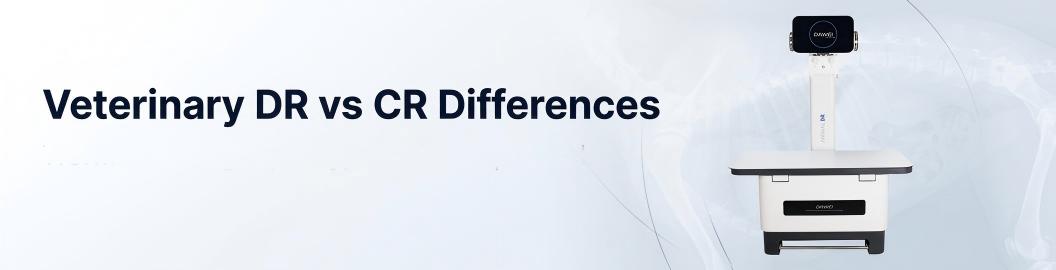
Veterinary radiography has shifted rapidly from film to digital. Today, most clinics choosing a new veterinary X‑ray workflow are deciding between Computed Radiography (CR) and Digital Radiography (DR).
If you’re comparing a veterinary DR system vs veterinary CR system, this guide breaks down the real-world differences—image quality, workflow speed, dose efficiency, maintenance, and total cost—and shows where a modern veterinary DR solution (including Dawei Veterinary DR) can fit into your practice.
What is CR (Computed Radiography) in veterinary imaging?
CR (Computed Radiography) uses an imaging plate (phosphor plate) inside a cassette. After exposure, the cassette is carried to a CR reader/scanner, which converts the latent image into a digital image.
Typical veterinary CR workflow:
- Position patient + cassette
- Expose
- Walk cassette to CR reader
- Scan the plate (reader)
- View, process, export/print
CR is often considered an entry-level digital upgrade from film because it typically reuses familiar cassette-based positioning.
What is DR (Digital Radiography) for veterinary X‑ray?
DR (Digital Radiography) captures the X‑ray image directly with a flat panel detector (FPD). The image appears on the workstation quickly, without cassette scanning.
Typical veterinary DR workflow:
- Position patient + flat panel detector
- Expose
- Image appears in seconds
- Process, export to PACS, print, share
DR is the most common choice for clinics that prioritize speed, higher throughput, and consistent image quality.
DR vs CR in veterinary radiography: quick comparison table
| Item | Veterinary CR | Veterinary DR |
| Image capture method | Phosphor plate cassette + reader scan | Flat panel detector direct capture |
| Speed to first image | Slower (must scan plate) | Fast (often seconds) |
| Workflow complexity | More steps; more handling | Fewer steps; smoother workflow |
| Image consistency | Depends on plate condition + scanning | Stable with consistent detector performance |
| Dose efficiency | Can be good, varies by plate/reader | Often better efficiency with modern FPD/DQE |
| Space requirement | Needs CR reader area | DR workstation + detector; some systems are compact |
| Typical maintenance | Plate wear + reader maintenance | Detector care; fewer moving parts than readers |
| Best for | Budget upgrades, low throughput | Busy clinics, faster turnaround, higher throughput |
Deep dive: the key differences that matter in daily practice
1) Workflow speed and throughput
The biggest practical difference is speed. In DR, you eliminate the “walk-and-scan” step. For busy clinics, that means:
· faster positioning-to-image time
· less patient time under restraint/sedation
· smoother emergency workflows
Keywords covered: veterinary DR workflow, digital radiography veterinary, veterinary digital x-ray system.
2) Image quality, dynamic range, and diagnostic confidence
Modern veterinary DR uses high-performance detectors and wide grayscale depth to help visualize subtle density differences.
For example, Dawei’s veterinary DR flat panel detector specifications (from your provided materials) include:
· Pixel size: 139 μm
· Matrix: 3072 × 3072
· Spatial resolution: 3.6 lp/mm
· 16-bit dynamic output range
· Fast imaging speed (noted as complete shooting within ~3s in the RV-32 series materials)
These parameters are commonly associated with sharper detail and better low-contrast visibility—important for thorax, abdomen, and orthopedic studies.
Keywords covered: flat panel detector veterinary, 16-bit DR, veterinary digital radiography image quality.
3) Dose and efficiency (DQE matters)
Many DR systems use CsI (Cesium Iodide) scintillators for higher X‑ray conversion efficiency. Your product material highlights amorphous silicon + CsI:Tl, aiming for:
· improved quantum detection efficiency (DQE)
· potential for lower exposure dose while maintaining image quality
Note: Dose optimization depends on technique charts, patient size, positioning, and calibration. Always follow local regulations and clinical best practices.
4) Reliability and maintenance
CR systems often require ongoing attention to:
· plate/cassette wear
· dust/scratch artifacts
· reader calibration and mechanical maintenance
DR systems reduce steps and can simplify operations. Your RV-32 series materials also emphasize detector stability across typical room conditions (temperature/humidity ranges) and lower maintenance burden.
Dawei Veterinary DR options (naturally integrated)
Below is a practical summary of your Dawei Veterinary DR lines mentioned in the materials, so readers can map features to real clinic needs.
A) Dawei RV-32A / RV-32B animal DR room system highlights
Based on the RV-32A/RV-32B introduction:
· Compact footprint: ~180 × 90 cm, occupied area about 3 m²
· Built-in high voltage generator designed to save space and support dustproof/waterproof needs
· RV-32B includes a touch display to enable operation directly in the DR room
· Detector feature set includes:
· AED (Automatic Exposure Detection) optional trigger mode
· fast preview/imaging messaging in the material (real-time imaging)
· 16-bit output and strong dynamic range messaging
X-ray tube difference (from your slides):
· RV-32A tube assembly: Hangzhou Yuanzhi LQ16-XD51-20
· RV-32B tube assembly: Canon E7239X
Your material positions the Canon tube as more mature in bearing/target-surface technology, aiming for longer life and lower maintenance.
B) Dawei RV-5E portable veterinary DR (kit-style) highlights
From the RV-5E specification document, the RV-5E package includes:
· Portable X-ray equipment: DF-5D
· Flat panel detector: DT-4343W
· Laptop (DELL)
· Dawei DR image acquisition & processing software
Selected key parameters from the provided spec:
· Generator output power: 5.3 kW
· kV range: 40–125 kV (1 kV step)
· mA range: 10–100 mA
· Exposure time: 1–4000 ms
· Detector:
· sensor: a‑Si TFT
· scintillator: CsI:Tl
· effective array: 3072 × 3072
· pixel size: 139 μm
· effective area: 427 × 427 mm
· spatial resolution: 3.6 lp/mm
· A/D: 16-bit
· interface: Gigabit Ethernet
This is a strong fit for scenarios like mobile service, barn/field imaging (where permitted), overflow workflows, or clinics that want a portable DR solution.
Product comparison table (example decision aid)
|
Model |
Positioning |
Key differentiator |
Best for |
|
RV-32A |
DR room system |
Standard operation + domestic tube option |
High-throughput clinics wanting a DR room workflow |
|
RV-32B |
DR room system |
Touch screen operation + Canon tube option |
Clinics prioritizing convenience and premium tube longevity |
|
RV-5E |
Portable veterinary DR kit |
Portable generator + DT-4343W FPD + laptop workflow |
Mobile imaging, mixed rooms, clinics needing portability |
FAQ: Veterinary DR vs CR
1) Is DR better than CR for veterinary X‑ray?
DR is usually better for speed and workflow efficiency because it avoids plate scanning. Image quality can also be more consistent with a modern flat panel detector, but “better” depends on your clinic’s volume, budget, and workflow.
2) Does DR reduce radiation dose compared with CR?
A modern DR detector (often CsI scintillator with good DQE) can help achieve diagnostic images at lower dose, but dose depends heavily on technique, positioning, collimation, and calibration. Always follow clinical protocols.
3) What does AED mean on a flat panel detector?
AED (Automatic Exposure Detection) is a detector trigger mode that can detect exposure and help streamline capture timing. Your RV-32 series materials mention AED as an optional trigger mode.
4) How fast is a veterinary DR system?
Many DR systems can display images within seconds. Your RV-32 series materials emphasize very fast imaging (e.g., complete shooting within ~3 seconds) to improve real-time diagnosis and workflow.
5) Can I connect veterinary DR images to PACS or printers?
Yes. Your imaging software description highlights DICOM 3.0 communication capability and support for DICOM film printers, which helps with PACS integration and printing.
Deep dive: the key differences that matter in daily practice
1) Workflow speed and throughput
The biggest practical difference is speed. In DR, you eliminate the “walk-and-scan” step. For busy clinics, that means:
· faster positioning-to-image time
· less patient time under restraint/sedation
· smoother emergency workflows
Keywords covered: veterinary DR workflow, digital radiography veterinary, veterinary digital x-ray system.
2) Image quality, dynamic range, and diagnostic confidence
Modern veterinary DR uses high-performance detectors and wide grayscale depth to help visualize subtle density differences.
For example, Dawei’s veterinary DR flat panel detector specifications (from your provided materials) include:
· Pixel size: 139 μm
· Matrix: 3072 × 3072
· Spatial resolution: 3.6 lp/mm
· 16-bit dynamic output range
· Fast imaging speed (noted as complete shooting within ~3s in the RV-32 series materials)
These parameters are commonly associated with sharper detail and better low-contrast visibility—important for thorax, abdomen, and orthopedic studies.
Keywords covered: flat panel detector veterinary, 16-bit DR, veterinary digital radiography image quality.
3) Dose and efficiency (DQE matters)
Many DR systems use CsI (Cesium Iodide) scintillators for higher X‑ray conversion efficiency. Your product material highlights amorphous silicon + CsI:Tl, aiming for:
· improved quantum detection efficiency (DQE)
· potential for lower exposure dose while maintaining image quality
Note: Dose optimization depends on technique charts, patient size, positioning, and calibration. Always follow local regulations and clinical best practices.
4) Reliability and maintenance
CR systems often require ongoing attention to:
· plate/cassette wear
· dust/scratch artifacts
· reader calibration and mechanical maintenance
DR systems reduce steps and can simplify operations. Your RV-32 series materials also emphasize detector stability across typical room conditions (temperature/humidity ranges) and lower maintenance burden.
Dawei Veterinary DR options (naturally integrated)
Below is a practical summary of your Dawei Veterinary DR lines mentioned in the materials, so readers can map features to real clinic needs.
A) Dawei RV-32A / RV-32B animal DR room system highlights
Based on the RV-32A/RV-32B introduction:
· Compact footprint: ~180 × 90 cm, occupied area about 3 m²
· Built-in high voltage generator designed to save space and support dustproof/waterproof needs
· RV-32B includes a touch display to enable operation directly in the DR room
· Detector feature set includes:
· AED (Automatic Exposure Detection) optional trigger mode
· fast preview/imaging messaging in the material (real-time imaging)
· 16-bit output and strong dynamic range messaging
X-ray tube difference (from your slides):
· RV-32A tube assembly: Hangzhou Yuanzhi LQ16-XD51-20
· RV-32B tube assembly: Canon E7239X
Your material positions the Canon tube as more mature in bearing/target-surface technology, aiming for longer life and lower maintenance.
B) Dawei RV-5E portable veterinary DR (kit-style) highlights
From the RV-5E specification document, the RV-5E package includes:
· Portable X-ray equipment: DF-5D
· Flat panel detector: DT-4343W
· Laptop (DELL)
· Dawei DR image acquisition & processing software
Selected key parameters from the provided spec:
· Generator output power: 5.3 kW
· kV range: 40–125 kV (1 kV step)
· mA range: 10–100 mA
· Exposure time: 1–4000 ms
· Detector:
· sensor: a‑Si TFT
· scintillator: CsI:Tl
· effective array: 3072 × 3072
· pixel size: 139 μm
· effective area: 427 × 427 mm
· spatial resolution: 3.6 lp/mm
· A/D: 16-bit
· interface: Gigabit Ethernet
This is a strong fit for scenarios like mobile service, barn/field imaging (where permitted), overflow workflows, or clinics that want a portable DR solution.
Post time: Mar-10-2026