


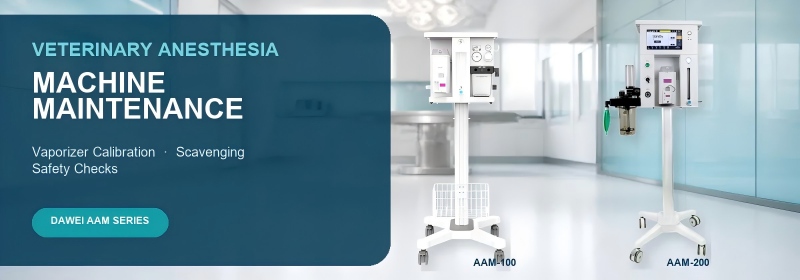
Quick answer
Effective veterinary anesthesia machine maintenance combines three layers: a leak and function check before every patient, routine cleaning and consumable replacement, and periodic inspection by a qualified service technician. The vaporizer must deliver the selected agent predictably, the breathing circuit must remain leak-free, and the scavenging system must carry waste anesthetic gas away from staff and patients. If the machine cannot hold pressure, the oxygen supply is unstable, the vaporizer is damaged or overdue for service, or the scavenger is obstructed, remove the system from clinical use until the fault is corrected.
The American Animal Hospital Association (AAHA) recommends leak-testing the machine and breathing circuit before anesthetizing each patient and after changing breathing-circuit components. The U.S. National Institute for Occupational Safety and Health (NIOSH) also emphasizes that anesthesia machines, vaporizers, ventilators, and scavenging systems should be inspected and maintained according to their manufacturers’ recommendations.
Why anesthesia machine maintenance matters
An inhalation anesthesia system is a chain: gas supply, flowmeter, vaporizer, common gas outlet, breathing circuit, valves, reservoir bag, carbon-dioxide absorber, patient connection, and scavenging path. A fault at any point can change delivered gas concentration, increase breathing resistance, allow rebreathing of carbon dioxide, or release waste anesthetic gas into the room.
Maintenance therefore supports two safety goals at the same time:
- Patient safety: stable oxygen delivery, predictable anesthetic delivery, low circuit resistance, and controlled airway pressure.
- Occupational safety: fewer leaks and reliable removal of waste anesthetic gas from treatment and recovery areas.
This guide is a maintenance framework, not a substitute for the instructions for a specific machine, vaporizer, circuit, absorber, or active vacuum interface.
1. Perform an anesthesia machine safety check before every patient
AAHA advises teams to leak-test the machine and circuit before each patient and after any breathing-circuit component is changed. Use the test method stated in the equipment manual because rebreathing and non-rebreathing circuits do not always use the same procedure.
Pre-use inspection sequence
- Confirm the gas source. Verify that the oxygen source is connected, available, and appropriate for the planned case. Inspect cylinder yokes, pipeline hoses, regulators, and pressure indicators for damage or abnormal readings.
- Inspect the vaporizer. Confirm that the installed vaporizer is intended for the anesthetic agent in use, is upright and securely mounted, contains an appropriate amount of agent, and has no evidence of liquid leakage or physical damage.
- Follow the gas pathway. Trace the system from the gas source through the flowmeter, vaporizer, common gas outlet, circuit, patient connection, reservoir bag, adjustable pressure-limiting (APL) valve, and scavenger.
- Check hoses and connectors. Look for cracks, loose fittings, kinks, moisture, missing seals, and incorrectly seated valves.
- Run the specified leak test. Use the manufacturer’s procedure. If the circuit does not hold pressure or the result is uncertain, do not connect a patient until the source is found and corrected.
- Verify the scavenger. Make sure the scavenging hose is connected, unobstructed, and routed to the intended active, passive, or adsorption system.
- Return controls to a safe start position. Reopen any valve closed for testing and restore the machine to the setup specified by the clinic’s checklist.
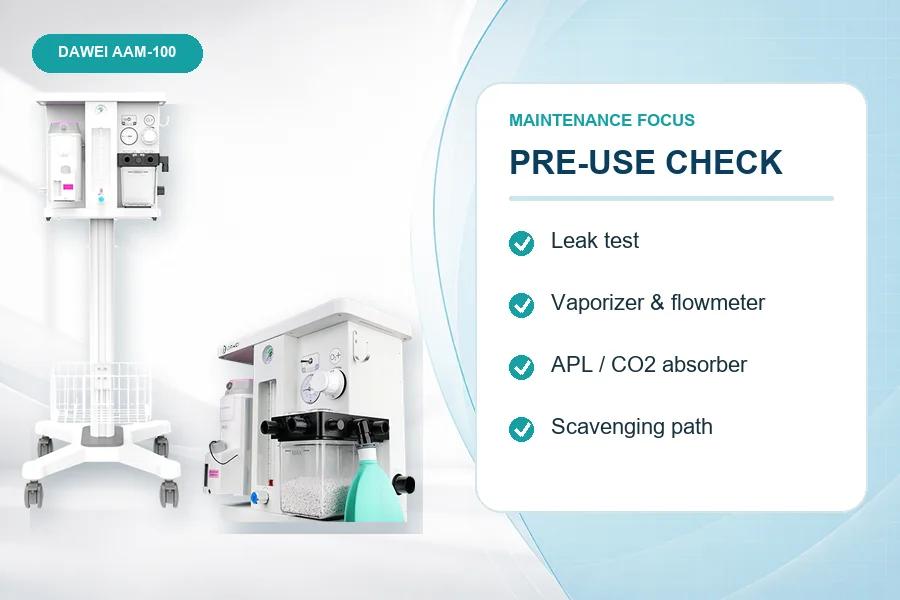
A failed leak test is a stop signal
Do not compensate for a suspected leak by simply increasing oxygen flow. Excess flow can mask the fault without fixing it, increase anesthetic consumption, and add waste gas to the scavenging load. Common leak points include worn breathing hoses, reservoir bags, absorber-canister seals, vaporizer mounting seals, open drain valves, and loose connectors. Service records should document the fault, corrective action, and person who returned the machine to use.
2. Understand vaporizer calibration in veterinary practice
A precision vaporizer is designed for a particular volatile anesthetic agent. Its dial position is not, by itself, proof that the delivered concentration is accurate. Output can be affected by calibration drift, contamination, tipping, incorrect filling, damaged seals, temperature, back pressure, and wear.
What the clinical team can check
Routine users can inspect the vaporizer exterior and installation without opening the sealed device:
- agent label and filler compatibility;
- secure, upright mounting;
- appropriate fill level;
- smooth dial operation and a positive OFF position;
- absence of liquid anesthetic, odor, corrosion, impact damage, or loose fittings;
- current service label and accessible maintenance record.
What requires a qualified technician
Formal vaporizer calibration for veterinary use requires a calibrated gas analyzer and agent-specific testing across multiple dial settings and flow conditions. Internal adjustment, wick replacement, seal replacement, or correction after tipping should be handled by a qualified service provider following the vaporizer manufacturer’s procedure.
Many service organizations use annual inspection and calibration as a practical baseline, but there is no single interval that applies to every vaporizer. Follow the device manual, local regulation, service history, usage level, and the technician’s findings. Arrange an earlier check after a drop or tip, visible damage, contamination, unexplained anesthetic consumption, unusual patient response, or analyzer readings that do not match the selected setting.
3. Maintain the waste anesthetic gas scavenging system
Waste anesthetic gas can escape from circuit leaks, masks, loose endotracheal-tube cuffs, connection and disconnection, and recovery-area exhalation. NIOSH notes that veterinary staff may be exposed when operating rooms lack effective scavenging or when anesthesia and scavenging equipment is not properly maintained.
Scavenging inspection points
- Trace the path from the APL valve or circuit exhaust port to the scavenger connection.
- Confirm that hoses are connected, unkinked, and free of liquid or debris.
- Check that an active interface is neither pulling excessive negative pressure nor failing to draw, using the manufacturer’s test.
- For passive systems, verify that tubing reaches the approved discharge location and does not create excessive back pressure.
- If an activated-charcoal canister is used, record its starting weight, accumulated use, orientation, and replacement threshold exactly as its manufacturer specifies. Charcoal canisters do not capture nitrous oxide.
- Include recovery areas in the facility’s waste-gas control plan because animals can continue to exhale anesthetic vapor after disconnection.
NIOSH recommends maintaining and monitoring scavenging systems and keeping inspection records. If staff smell anesthetic, experience recurrent headaches or dizziness, or observe a damaged or disconnected scavenging pathway, stop and investigate rather than treating odor as a normal part of anesthesia.
4. Inspect the APL valve, CO2 absorber, valves, and breathing circuit
The APL valve controls how circuit pressure is released in manual and spontaneous ventilation. It should move smoothly and be positioned according to the mode of use. A stuck, obstructed, or incorrectly set valve can create unsafe circuit pressure or an uncontrolled leak.
For rebreathing systems, inspect the carbon-dioxide absorber canister for correct seating, intact seals, excessive dust, channeling, moisture, and exhausted absorbent. Do not rely only on color. Some absorbents can partially return toward their original color after resting even though useful capacity has been consumed. Track use and replace absorbent according to the absorbent and machine manufacturers’ instructions.
Clean and dry reusable breathing components with compatible products. Replace cracked hoses, stretched connectors, sticky unidirectional valves, damaged reservoir bags, hardened gaskets, and any single-use component that has reached its limit. Never allow cleaning liquid to enter a vaporizer.
Recommended veterinary anesthesia maintenance schedule
| Frequency | Maintenance actions | Record |
|---|---|---|
| Before every patient | Gas supply, vaporizer exterior and fill, circuit setup, leak test, reservoir bag, valves, absorber seating, scavenger path, safe control positions | Initials or digital checklist; fault if found |
| After circuit changes | Repeat the manufacturer-specified leak and function checks | Component changed and result |
| After use / daily | Clean compatible external surfaces and reusable components; drain moisture where instructed; inspect for damage; turn off gas supply and vaporizer per local SOP | Cleaning completion and abnormal findings |
| Weekly or according to workload | Inspect hoses, bags, seals, valve movement, absorber condition, flowmeter tube, mounting hardware, wheels or wall/desktop mount, and scavenging connections | Condition and replacements |
| According to consumable instructions | Replace CO2 absorbent, filters, adsorption canisters, batteries, and single-use parts at the specified threshold | Lot/date, hours or weight where applicable |
| At the manufacturer’s service interval and after an incident | Technician inspection of gas delivery, pressure relief, oxygen flush, flowmeter accuracy, vaporizer output, seals, valves, breathing system, and scavenger performance | Service report and calibration results |
The table is a framework. A clinic should convert it into a model-specific checklist using the machine and accessory manuals.
Choosing the right Dawei anesthesia system and maintenance focus
For clinics evaluating a new veterinary inhalation anesthesia system, maintenance planning should reflect the patient range and equipment architecture. Dawei’s current anesthesia range includes the AAM-100, AAM-150, and AAM-200. The following descriptions use only specifications stated on the official product pages.
AAM-100: flexible inhalation anesthesia for small and medium animals
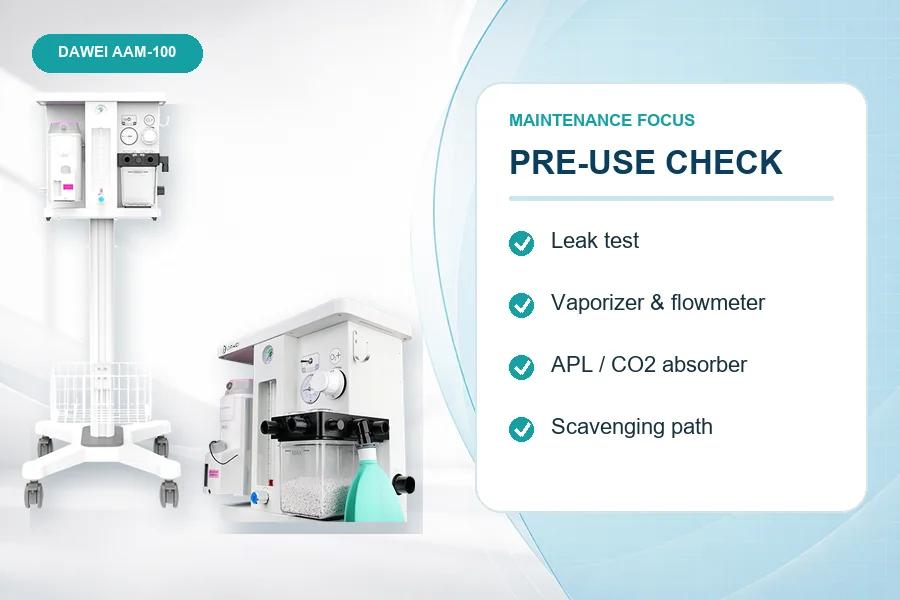
The Dawei AAM-100 Veterinary Anesthesia Machine is intended for small and medium-sized animals in veterinary hospitals and experimental institutions. It supports closed-loop and open-loop modes and can be configured for trolley, desktop, or wall-mounted use. Official product information also lists:
- a 4 L high-precision flowmeter, 1 MPa gas pressure gauge, and 0.8 MPa safety valve;
- a Selectatec vaporizer mounting system designed for easier vaporizer replacement;
- an all-metal ACGO diverter switch with a separate ACGO interface;
- a pre-calibrated APL valve for one-step airway-pressure setting; and
- a CO2 absorber canister with a toggle-locking structure for easier replacement and cleaning.
For maintenance planning, pay particular attention to secure vaporizer mounting, ACGO selection, APL-valve movement, absorber-canister seals, and the leak integrity of whichever breathing circuit is installed.
AAM-150: compact isoflurane anesthesia for mice and other small animals
The Dawei AAM-150 Small Animal Anesthesia Machine is designed for small animals such as mice and delivers an oxygen-and-anesthetic mixture through a face mask. Dawei describes a fully enclosed, integrated, ready-to-use design with a high-precision vaporizer, temperature compensation, flow compensation, rapid oxygen supply, a high-efficiency recovery canister for anesthetic exhaust gas, individual vaporizer adjustment, stable concentration output, EasyFill filling, and strong sealing.
Its maintenance plan should include exterior leak inspection, flowmeter and oxygen-supply checks, verification of the agent and filler system, documented vaporizer output service, mask and tubing inspection, and replacement of the recovery canister at its specified threshold. A recovery canister must never be treated as unlimited-capacity scavenging.
AAM-200: anesthesia delivery with integrated ventilation
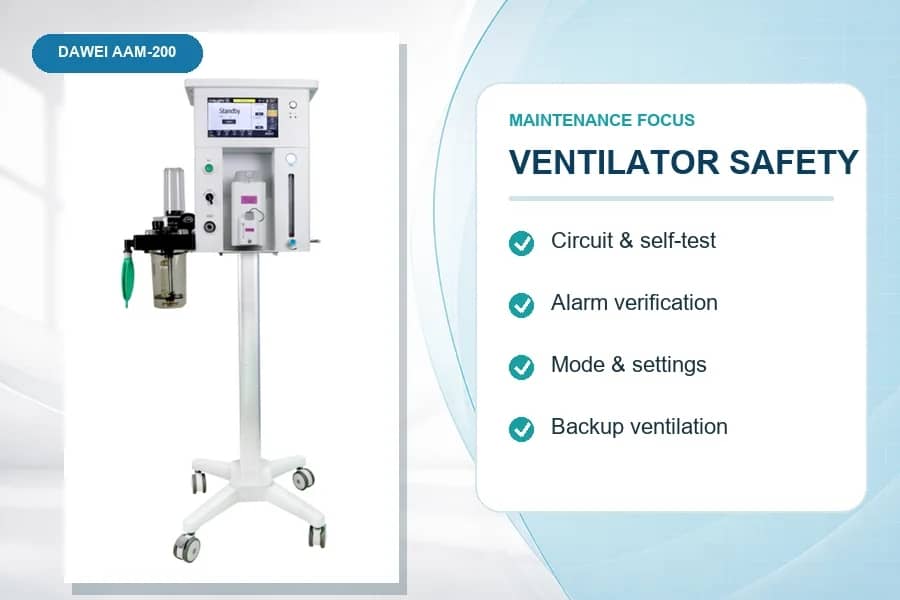
The Dawei AAM-200 Veterinary Anesthesia Breathing Machine is suitable for large, medium, and small animals. Its official product page lists a 10.1-inch color touchscreen, weight-based recommended ventilation parameters, parameter and waveform monitoring, a minimum tidal volume of 5 mL, and VCV, PCV, VS, and SIMV-VC/PC ventilation modes. An ACGO switch provides one-click selection between non-circular and circular circuits.
Because the AAM-200 adds mechanical ventilation, its pre-use process should cover both the anesthesia-delivery pathway and the ventilator checks stated in the model manual. In addition to leak, vaporizer, absorber, and scavenger checks, confirm the breathing circuit, ventilator self-test, alarms, selected mode, patient-specific settings, and backup ventilation plan before connection.
These features can improve access and workflow, but no model removes the need for a pre-use leak test, a functioning scavenger, documented vaporizer service, and model-specific training. Buyers should confirm the supplied vaporizer, breathing circuits, gas-source compatibility, scavenging configuration, accessories, service coverage, and calibration documentation for their market before purchase.
When should a veterinary anesthesia machine be removed from service?
Remove the system from clinical use and label it clearly if any of the following occurs:
- a leak test fails or the source of pressure loss cannot be identified;
- gas supply, regulator, pressure gauge, flowmeter, oxygen flush, or safety valve behaves abnormally;
- the vaporizer has been dropped, tipped, contaminated, damaged, is leaking, or produces suspect output;
- the APL valve, unidirectional valve, or selector does not move or function correctly;
- the absorber canister or breathing circuit cannot be sealed correctly;
- the scavenging system is disconnected, blocked, damaged, or creates abnormal pressure;
- staff detect persistent anesthetic odor or experience symptoms associated with exposure; or
- service or calibration status cannot be confirmed when the manual requires it.
Use backup equipment only after it has passed its own pre-use check. Document the failure and release the original machine only after repair and verification.
Frequently asked questions
How often should a veterinary anesthesia machine be leak-tested?
Leak-test the machine and breathing circuit before every patient and after changing any breathing-circuit component, following the model-specific procedure. Also repeat the check whenever a leak is suspected.
How often should a veterinary vaporizer be calibrated?
Use the interval in the vaporizer manufacturer’s instructions and the service provider’s documented recommendation. Annual inspection is a common service baseline, but heavy use, a tip or drop, contamination, damage, unusual agent consumption, or questionable analyzer readings justify earlier testing.
Can clinic staff calibrate a vaporizer themselves?
Staff can perform exterior, mounting, fill, leak, and service-label checks. Output verification and internal adjustment require appropriate gas-analysis equipment, agent-specific procedures, and a qualified technician.
What is the purpose of a scavenging system?
It collects waste anesthetic gas from the breathing system and directs it to an active exhaust, approved passive discharge, or compatible adsorption system. Its purpose is to reduce staff exposure without creating unsafe positive or negative pressure in the patient’s breathing circuit.
Is absorbent color enough to decide when to change a CO2 canister?
No. Color is only one indicator and may change after the absorbent rests. Follow the absorbent manufacturer’s instructions and consider tracked use, inspired CO2 monitoring, dust, channeling, moisture, and the canister’s physical condition.
What records should a veterinary clinic keep?
Keep pre-use checklists, fault reports, consumable-change logs, vaporizer calibration reports, machine and scavenger service records, exposure investigations, and staff training records. Documentation makes recurring failures easier to identify and supports a consistent safety program.
Post time: Aug-27-2026