


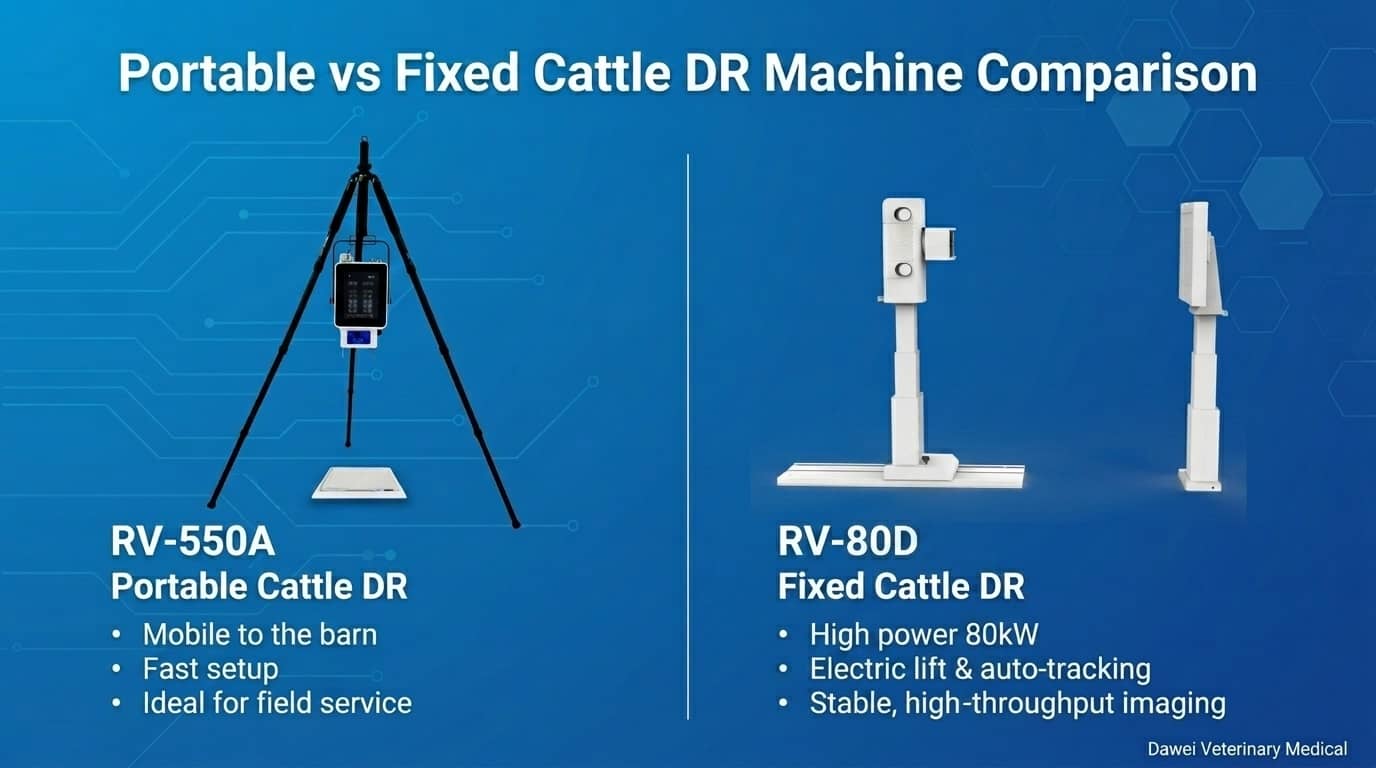
In bovine practice, cattle DR (also searched as bovine DR, cattle digital radiography, cattle X-ray machine, bovine X-ray system) is mainly about one thing: getting a diagnostic image with less time, less stress, and fewer re-takes.
But the real decision usually comes down to two very different operating models:
- Portable cattle DR machine: the system goes to the cow (barn, chute, field service).
- Fixed cattle DR system: the cow comes to the system (a dedicated imaging point, higher standardization).
Quick decision summary
- Choose portable cattle DR (e.g., RV-550A) if you do barn-side imaging, mobile service, or multi-site work.
- Choose a fixed cattle DR system (e.g., RV-80D) if you need stable, repeatable positioning and high-throughput imaging in a dedicated area.
- Many mature teams end up with a two-tier setup: portable for field calls + fixed for a central imaging point.
Portable vs fixed cattle DR machine: side-by-side table
| Dimension | Portable cattle DR (RV-550A) | Fixed cattle DR (RV-880D) |
| Where it shines | Barn, farm, mobile service | Dedicated imaging point / center station |
| Workflow | “Bring DR to the cow” | “Bring the cow to DR” |
| Setup & flexibility | Highly flexible; quick deployment | Requires site planning; consistent setup |
| Image consistency | More affected by on-site variables | More repeatable positioning & workflow |
| Throughput | Medium (depends on team & field conditions) | High (better for batch imaging) |
| Power & sustained output | Optimized for mobility | Typically optimized for higher power & continuous use (e.g., 80kW-class configurations) |
| Site requirements | Minimal | Space + cabling + shielding planning (as applicable) |
| Best fit | Field vets, large-area farms, emergency calls | Imaging centers, large farms, standardized check programs |
When a portable cattle DR machine (RV-550A) is the best choice
Portable systems tend to win when real life is messy: uneven ground, limited space, variable restraint, fragmented schedules.
Typical use cases
- Lameness and limb screening: quick checks for fractures, joints, hoof-related issues (depending on protocol).
- Farm-side service: reduce transport stress and waiting time.
- Multi-site coverage: one team serving multiple farms or stations.
Why it matters
- You reduce the hidden costs of moving cattle: labor, time, stress, and workflow interruptions.
- Portable DR supports a “high responsiveness” service model—especially valuable for field veterinarians
When a fixed cattle DR system (RV-80D) makes more sense
A fixed setup is not just “less mobile.” It’s a different productivity strategy:
- Repeatability (positioning, protocol, results)
- Standardization (training, QA, fewer re-takes)
- Throughput (batch imaging becomes smoother)
Typical use cases
- Large farms / breeding bases with scheduled imaging.
- Regional imaging centers that serve surrounding farms.
- High-frequency programs where consistency is the KPI.
6 questions that prevent the “wrong” purchase
- Is your work multi-site or centralized?
- Multi-site → portable weight increases.
- Centralized → fixed weight increases.
- Do you optimize for single-case speed or batch throughput?
- Portable excels at “arrive and shoot.”
- Fixed excels at “repeat, standardize, scale.”
- Who operates the system day-to-day?
- The more operators you have, the more you benefit from fixed workflow standardization.
- What’s your biggest cost: transport, re-takes, or downtime?
- Portable reduces transport friction.
- Fixed reduces variability and re-takes in high volume.
- What will your case volume look like in 12 months?
- Growing coverage area → portable is easier to redeploy.
- Growing centralized volume → fixed scales better.
- Should you plan for a two-tier setup?
- Portable for field calls + fixed for a central station is common when services mature.
FAQ (cattle DR keywords)
What is “cattle DR”?
Cattle DR means digital radiography for cattle—a digital X-ray workflow typically using a flat panel detector, image processing software, and DICOM-compatible output (depending on configuration).
Can a portable cattle X-ray machine deliver diagnostic-quality images?
Yes—image quality depends on positioning, restraint, exposure settings, and post-processing, not only hardware. Field conditions increase the importance of a good protocol.
Is fixed cattle DR only about higher power?
Power matters, but fixed systems often deliver their biggest advantage through repeatability, standardization, and throughput.
Is portable always cheaper than fixed?
Not necessarily. Compare total cost of ownership: labor, cattle movement, re-takes, scheduling, downtime, and service logistics.
Post time: Apr-21-2026