


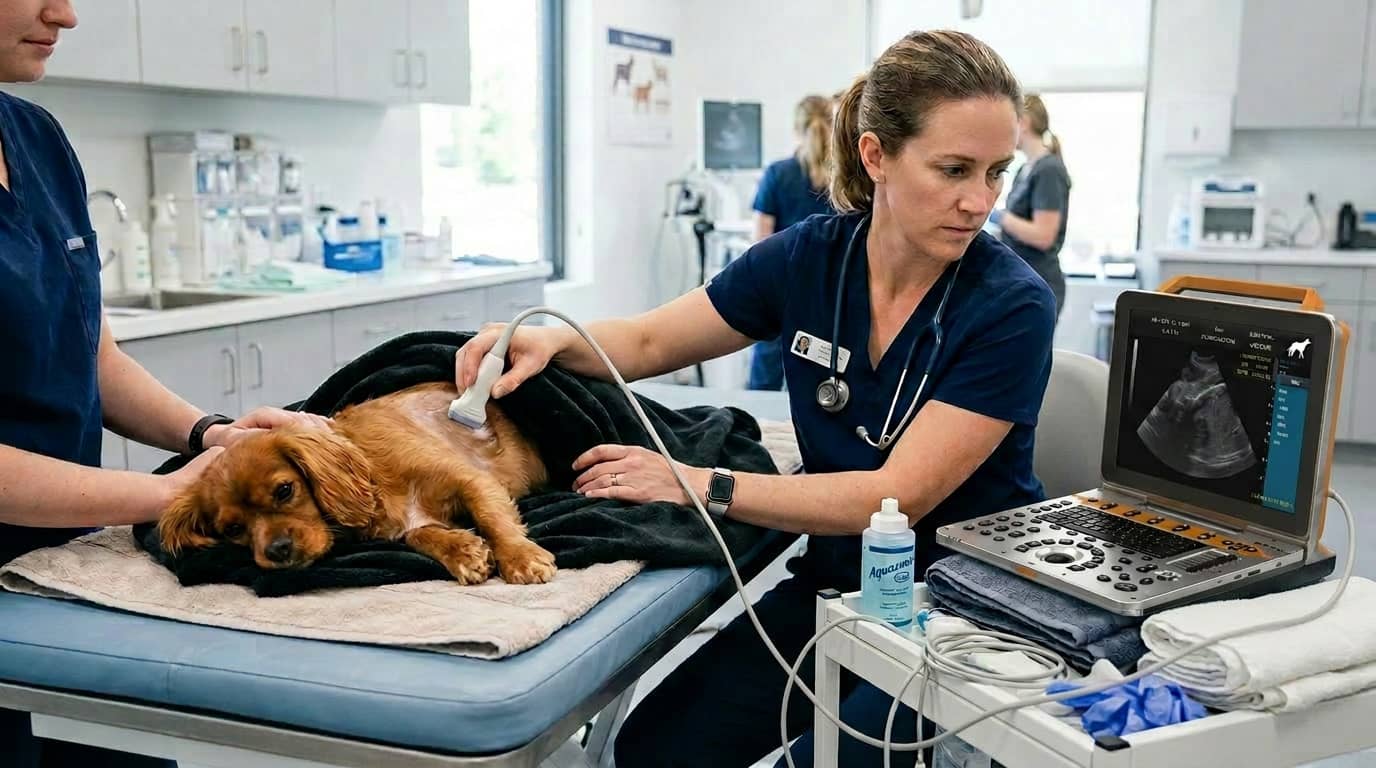
Small-animal cardiology depends on two things: getting a clean Doppler tracing and getting reliable numbers fast enough to matter during a real exam. That is exactly where PW Doppler Spectrum Auto Envelope becomes valuable in daily practice. For veterinarians handling dog ultrasound machine workflows, feline heart scanning, and other companion-animal cardiac cases, the feature shortens measurement time, reduces manual tracing variability, and helps standardize Doppler reporting across operators.
When paired with a Micro-convex Probe R11, the system becomes especially practical for cats, toy breeds, and small-to-medium dogs because the probe footprint fits the intercostal spaces well while still giving enough field of view for routine cardiac and abdominal work.
Why PW Doppler Auto Envelope Matters in Small-Animal Cardiology
In canine and feline echocardiography, heart rates are fast, waveforms are compact, and repeatability matters. Manual tracing is possible, of course, but it takes more time and introduces more operator-to-operator variation. A system equipped with Auto Spectrum Envelope or AUTO TRACE can automatically outline the Doppler spectrum and calculate hemodynamic values from the waveform in seconds.
For clinics searching terms like dog ultrasound machine, canine cardiac ultrasound, cat heart ultrasound, feline heart scanning, or veterinary Doppler ultrasound, this is not just a convenience feature. It directly improves workflow in:
- · Mitral and tricuspid inflow assessment
- · Aortic and pulmonary outflow measurement
- · Renal and peripheral vascular evaluation when needed
- · Follow-up comparisons in chronic cardiac patients
- · Faster reporting in busy pet hospitals and referral centers
Why the Micro-convex Probe R11 Fits Dog and Cat Heart Scanning
For small-animal echo, probe choice changes everything. A large abdominal convex transducer may struggle between ribs, while a phased-array probe may not always be the first choice on mixed-use portable systems. The Micro-convex Probe R11 sits in a very useful middle ground:
- · Small footprint: easier intercostal access in cats and small dogs
- · Versatile field of view: suitable for both cardiac and abdominal work
- · Practical for general practice: one probe can support more than one clinical scenario
- · Comfortable handling: useful in restrained but awake companion animals
That is why many clinics evaluating a dog ultrasound machine for general practice prioritize a micro-convex option, especially when they want one system to handle both abdominal and cardiac cases.
What the Auto Spectrum Envelope Can Output
Once the PW Doppler gate is placed correctly and the spectral signal is clean, the system’s real-time automatic spectrum envelope function can automatically analyze the tracing and generate core measurements. Depending on software version and exam preset, veterinarians may see some or all of the following:
- · PS / PSV — peak systolic velocity
- · ED / EDV — end-diastolic velocity
- · PI — pulsatility index
- · RI — resistive index
- · S/D — systolic to diastolic ratio
- · HR — heart rate
- · Additional time or velocity-derived indices depending on preset and package
In practice, that means the operator no longer has to manually trace each spectral peak and diastolic endpoint for every sample. Instead, the system recognizes the envelope, follows the waveform contour, and outputs measurements instantly for review.
Step-by-Step: How Veterinarians Use Auto Spectrum Envelope in Dog and Cat Cardiac Exams
Below is a practical workflow you can use in a real canine or feline cardiac study.
1. Prepare the patient for a stable cardiac scan
- · Place the dog or cat in the position preferred by your clinic protocol, commonly right or left lateral recumbency for echocardiography.
- · Minimize stress, because tachycardia and motion will degrade Doppler quality.
- · Clip and apply gel if necessary to improve contact.
- · Select the cardiac preset or the most appropriate small-animal cardiac examination preset.
For feline heart scanning, gentle handling matters even more. Cats often produce usable windows quickly, but they can also tense up just as quickly, which narrows the window and destabilizes the spectral trace.
2. Select the Micro-convex Probe R11
Choose the R11 micro-convex probe for small-animal cardiac access when your system configuration supports it. The compact footprint helps the probe sit between ribs and capture useful windows in cats and dogs without forcing awkward angles.
This is one reason the R11 is a strong fit for clinics that want a single dog ultrasound machine to cover both cardiac and abdominal examinations in companion animals.
3. Acquire the standard B-mode cardiac view first
Before turning on Doppler, make sure the anatomy is correct in B-mode.
- · Identify the chamber or vessel you want to interrogate
- · Optimize depth so the heart occupies a useful portion of the image
- · Adjust gain to avoid unnecessary background noise
- · Fine-tune focus and overall image clarity
Good Doppler starts with good grayscale imaging. If the B-mode view is off-axis, the Doppler measurement will be less reliable no matter how advanced the software is.
4. Activate color flow when needed to localize the jet or flow path
Color Doppler helps you identify the exact flow region before switching into PW Doppler.
Use this step to:
- · confirm inflow direction across the mitral or tricuspid valve
- · localize left ventricular outflow or right ventricular outflow
- · identify the center of a laminar stream for better sample placement
- · avoid placing the Doppler gate in turbulent or mixed-flow regions unless that is your clinical target
5. Switch to PW Doppler mode
Activate PW Doppler after localizing the flow.
Then:
- · place the sample volume at the intended measurement site
- · keep the sample gate appropriately sized for the structure
- · align the Doppler cursor as parallel to blood flow as possible
- · apply angle correction only according to your protocol and anatomy
This is the moment that determines whether the auto measurement feature will perform well. A clean, crisp spectrum is essential.
6. Optimize the spectral waveform before using Auto Envelope
Do not rush into measurement the second a trace appears. First, improve the signal:
- · reduce spectral broadening when possible
- · adjust baseline if the waveform is clipped
- · set sweep speed so the waveform is easy to separate beat-to-beat
- · optimize Doppler gain to avoid filling in the spectral window excessively
- · obtain several stable cardiac cycles
In dogs with higher heart rates or anxious cats, a slightly longer observation window often gives a better cycle for automatic analysis.
7. Turn on Auto Spectrum Envelope / AUTO TRACE
Once the waveform is stable, activate the system’s Auto Spectrum Envelope function, also described on some systems as Doppler spectrum automatic envelope or AUTO TRACE.
At this point, the system automatically:
1. detects the spectral border of the waveform
2. traces the upper and relevant lower contour in real time
3. analyzes the Doppler cycle
4. calculates the associated hemodynamic parameters
5. displays the output values on-screen for review and storage
This is the key step that transforms a raw spectral tracing into structured clinical data.
8. Review the automatically generated parameters
After the envelope is drawn, review the measurement panel. The system can automatically analyze and output values such as:
- · PS / PSV for peak systolic flow velocity
- · ED / EDV for end-diastolic velocity
- · PI for downstream pulsatility assessment
- · RI for vascular resistance assessment
- · S/D for systolic-diastolic relationship
- · HR for heart rate derived from the Doppler cycle
In a small-animal workflow, these values are especially helpful when trending serial examinations, comparing sedated vs. awake studies, or standardizing measurements across multiple veterinarians.
9. Freeze, store, and compare repeat cycles
Even though the system automates the envelope, good clinical practice still requires operator judgment.
- · save the best representative cycle
- · repeat the measurement across additional cycles when rhythm is irregular
- · compare auto-traced results with the visual waveform
- · re-run the measurement if the envelope appears to follow noise rather than true flow
Automation is a speed tool, not a substitute for interpretation.
10. Export results into the patient record
After confirming the measurement quality, store images, cine loops, and numerical results in the patient file.
That makes follow-up easier for:
- · chronic valvular disease monitoring
- · cardiomyopathy screening
- · post-treatment reassessment
- · internal medicine referrals
- · referral cardiology communication
Clinical Tips to Improve Auto Envelope Accuracy
If you want more reliable measurements from your veterinary Doppler ultrasound workflow, these small adjustments make a big difference:
Keep the insonation angle as favorable as possible
Poor angle alignment lowers velocity accuracy and may distort the envelope shape.
Avoid noisy spectra
Too much gain, patient motion, or poor contact can make the algorithm trace artifact instead of flow.
Use several clean beats instead of the first beat
A stable series of cycles gives the system a better waveform to analyze.
Match the probe to the patient size
For cats, small dogs, and narrow intercostal spaces, the Micro-convex Probe R11 is often more practical than bulkier alternatives.
Re-check measurements in arrhythmia cases
Automatic output is still useful, but irregular rhythm can make beat selection more important.
Best Use Cases in Dogs and Cats
This workflow is especially practical for:
- · Dog heart ultrasound in mitral valve disease screening and follow-up
- · Canine cardiac ultrasound for outflow and inflow velocity assessment
- · Feline heart scanning in suspected cardiomyopathy cases
- · Cat heart ultrasound in general practice before referral
- · Mixed small-animal hospitals that need one efficient dog ultrasound machine for both routine and cardiac applications
FAQ
Is Auto Spectrum Envelope useful for a dog ultrasound machine in general practice?
Yes. It helps general-practice veterinarians obtain repeatable Doppler measurements faster, especially when the machine is used for both abdominal and cardiac work.
Why is the R11 micro-convex probe helpful for feline heart scanning?
Its smaller footprint is easier to position between ribs in cats, while still providing a practical field of view for small-animal exams.
Can Auto Spectrum Envelope replace clinical judgment?
No. It accelerates tracing and data output, but the veterinarian still has to verify gate placement, signal quality, waveform correctness, and clinical relevance.
Which values can be measured automatically?
Typical outputs include PS, ED, PI, RI, S/D, and HR, with additional values depending on software package and exam preset.
Post time: Jun-17-2026