


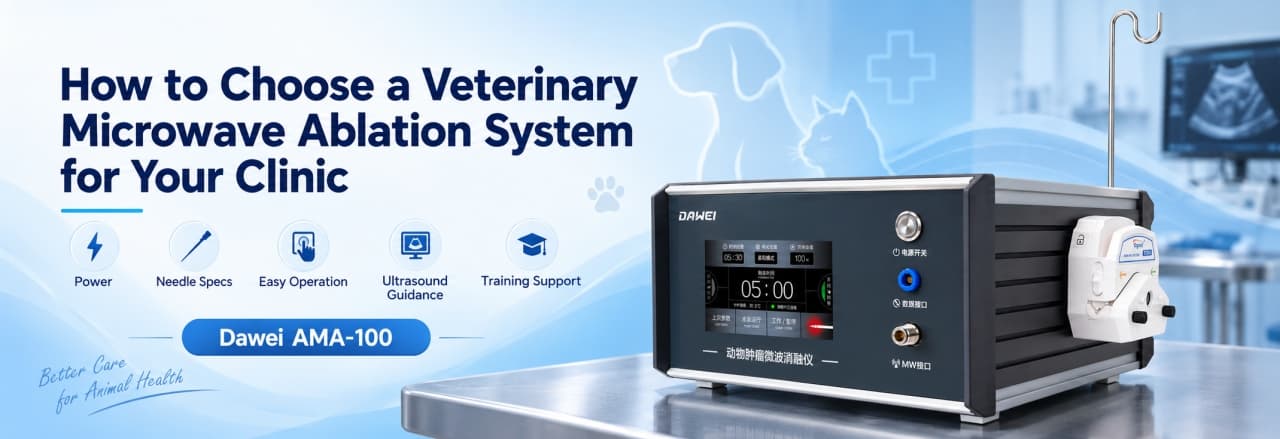
Choosing a veterinary microwave ablation system is not only about buying a new machine.
It is about adding a more advanced tumor treatment option to your clinic, especially for selected animal cases where traditional surgery may not be ideal. For animal hospitals, veterinary oncology departments, research institutions, and advanced pet clinics, the right system should be practical, controllable, safe to operate, and supported by reliable training.
So, what should veterinarians pay attention to before choosing a microwave ablation system?
Let’s break it down.
1. Understand What Veterinary Microwave Ablation Does
Veterinary microwave ablation is a minimally invasive tumor treatment method. It uses high-frequency electromagnetic energy released through an ablation needle into the target tumor tissue. Under the action of a high-frequency magnetic field, polar molecules in the tissue, mainly water molecules, rotate rapidly and generate heat. When the temperature rises above 60°C, tissue dehydration, coagulation, protein denaturation, and irreversible necrosis may occur.
In simpler words, the system uses controlled thermal energy to help veterinarians manage selected tumor lesions.
This is why microwave ablation is often discussed in relation to minimally invasive animal tumor treatment, veterinary oncology equipment, and image-guided tumor therapy.
2. Check Whether the System Matches Your Clinical Applications
Before comparing specifications, ask one important question:
What kind of tumor cases does your clinic want to manage?
According to the product information, animal tumor microwave ablation may be considered for solid tumors that cannot be surgically removed due to heart, lung, liver function, or other reasons. It may also be considered for tumors that cannot be completely removed by surgery, metastatic cancer foci, postoperative recurrence, multiple cancer foci, palliative treatment for advanced disease, or cases where other therapies are ineffective or have failed.
For a clinic, this means the equipment is not just a “machine.” It should be part of a broader tumor treatment workflow.
A good veterinary microwave ablation system should support:
small animal tumor treatment, dog and cat tumor care, selected advanced tumor cases, postoperative recurrence management, and palliative treatment planning.
However, not every animal or tumor is suitable. The product manual also lists contraindication considerations, especially for liver tumors with ascites, poor coagulation function, large tumor volume, unclear margins, or lesions close to important blood vessels, gallbladder, diaphragm, or intestinal tract.
That is why case selection, imaging evaluation, and veterinary judgment are essential.
3. Look at the Output Power Range
Power matters.
But more power does not always mean better treatment. A veterinary microwave ablation system should allow veterinarians to adjust energy output according to the treatment plan, tissue condition, ablation needle type, and target lesion size.
The Dawei AMA-100 animal tumor microwave ablation device supports microwave output power from 1 to 100W, continuously adjustable. Its microwave working frequency is 2450 MHz ±30 MHz.
This gives veterinarians flexibility when dealing with different treatment requirements.
When choosing a system, clinics should pay attention to:
Power adjustment range
Power stability
Needle compatibility
Temperature monitoring
Treatment time control
Different ablation modes
A system with adjustable power gives the operator more control. And in tumor ablation, control is critical.
4. Check the Ablation Modes
Not every treatment situation needs the same energy output pattern.
A useful veterinary microwave ablation system should offer different ablation modes, allowing veterinarians to choose a suitable output method depending on the treatment plan.
The Dawei system includes three ablation modes: Full Ablation, Burst Ablation, and Soft Ablation. Full Ablation uses continuous wave output. Burst Ablation uses intermittent wave output, driving microwave output at around 40% to 60% of the set power. Soft Ablation uses pulse wave or intermittent output at around 20% to 40% of the set power.
This is useful because clinical needs can vary.
Sometimes a veterinarian may want stronger continuous output. Sometimes a softer or intermittent mode may be more appropriate. Having multiple modes makes the system more adaptable to different workflows.
5. Pay Attention to the Ablation Needle
The ablation needle is one of the most important parts of the system.
It is the tool that delivers microwave energy into the treatment area. So, before choosing a microwave ablation machine, clinics should check the needle specifications carefully.
The Dawei AMA-100 host is compatible with the 16G160150L microwave ablation needle. The needle size is Φ1.6 × 150 mm, and the usage power is ≤60W.
For purchasing decisions, veterinarians should consider:
Needle gauge
Needle length
Compatible power
Needle cooling design
Whether the needle is disposable
Availability of replacement needles
Needle testing and safety features
The manual clearly states that the ablation needle is a disposable product and must not be reused.
This point is important for infection control, safety, and treatment reliability.
6. Consider Ultrasound or Image-Guided Use
Microwave ablation is not performed blindly.
In real clinical use, imaging guidance is highly important. The Dawei manual states that treatment starts by puncturing the microwave ablation needle into the treatment area under the guidance of imaging equipment and keeping it fixed. After cooling water circulates sufficiently, the system begins microwave output and ablation starts.
For veterinary clinics, this is a key purchasing point.
A microwave ablation system should work well with imaging equipment such as veterinary ultrasound. Ultrasound guidance can help the veterinarian locate the lesion, guide needle placement, and improve procedural confidence.
This also means clinics that already have veterinary ultrasound equipment can build a stronger tumor treatment workflow:
Diagnosis
Imaging evaluation
Needle placement
Microwave ablation
Follow-up assessment
For suppliers, this is also an important solution-selling angle. Instead of promoting only one machine, you can promote a complete veterinary oncology workflow.
7. Make Sure the Operation Is Practical for Daily Clinical Use
A machine can have strong specifications, but if it is difficult to operate, it may not be suitable for daily clinic use.
The Dawei system uses a touchscreen interface. The main interface includes treatment time, ablation mode, output power, operating time or remaining time, cumulative time, cumulative count, ablation needle status, antenna temperature, pump start, and start/stop controls.
This kind of interface helps the operator monitor important information during the procedure.
Another practical feature is control flexibility. The system supports both foot pedal start/stop and hand control start/stop. In foot pedal mode, microwave output time is controlled by stepping on and releasing the foot pedal switch. In hand control mode, output and stop are controlled through the touchscreen, and treatment time needs to be set.
For veterinary use, this matters.
During procedures, veterinarians often need their hands free. Foot pedal control can make operation more convenient. Touchscreen control can make parameter setting clearer. Both options give the operator more flexibility.
8. Check the Cooling and Temperature Monitoring Design
Thermal ablation requires careful temperature control.
The Dawei system includes a peristaltic pump and cold circulation water pipe as part of its structure. The product consists of the host, microwave output cable, microwave ablation needle, cold circulation water pipe, foot pedal switch, and power cord. The host itself includes a microwave source, control system, touchscreen, peristaltic pump, cooling medium container holder, and power supply.
During treatment, the cooling water pump should be turned on first. After the cooling water circulates sufficiently, ablation can begin.
The system also monitors the needle rod temperature. The technical specifications show a needle rod temperature monitoring function from 0°C to 45°C, and the host stops microwave output when the needle rod temperature exceeds 45°C.
9. Ask About Training and After-Sales Support
For advanced veterinary equipment, after-sales support is not optional.
It directly affects whether the clinic can use the system correctly and confidently.
The Dawei manual states that when the product is sold, the manufacturer or technical support unit can provide product usage training according to the contract agreement. It also states that the host is warranted for one year, and lifetime paid repair is available.
For clinics, this is a very practical purchasing factor.
Before buying, ask the supplier:
Will training be provided?
Is installation guidance available?
Is there an operation manual?
Are replacement needles available?
How long is the warranty?
Who provides technical support?
Can the supplier support remote guidance?
A veterinary microwave ablation system is not a simple plug-and-play device. Training helps reduce operation mistakes and supports better clinical workflow.
10. Review System Size, Power Supply, and Clinic Compatibility
Finally, clinics should check whether the system fits their working environment.
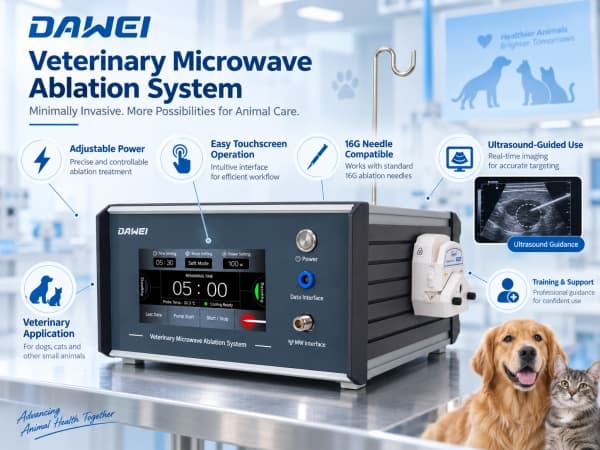
The AMA-100 is a desktop model with a single microwave source and intelligent temperature measurement. Its dimensions are 350 × 350 × 220 mm, weight is 15 kg, and power consumption is <500 VA.
Post time: Sep-10-2026