


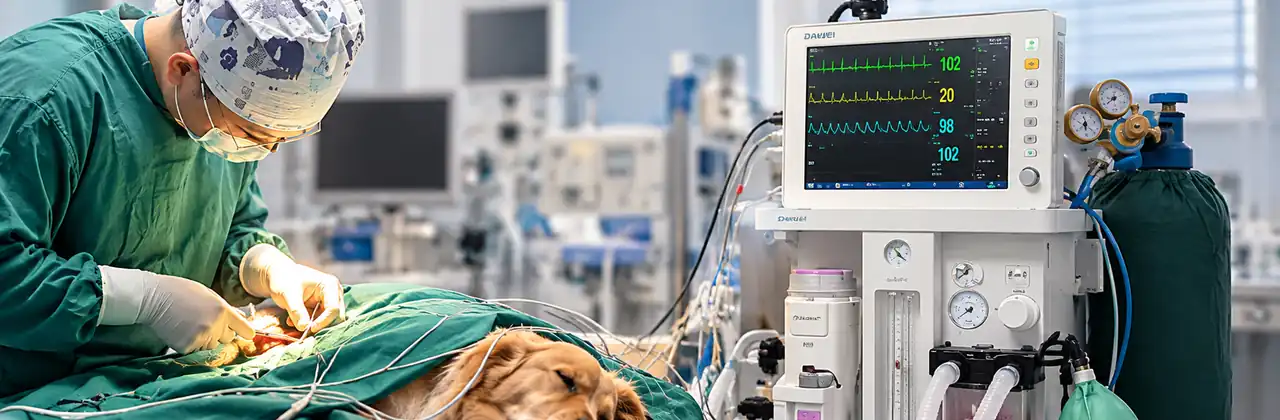
Choosing a veterinary patient monitor can be surprisingly difficult. Two monitors may look almost identical, display the same vital signs, and still offer very different experiences in daily clinical use.
For a small veterinary clinic, a straightforward monitor with reliable ECG, blood pressure, oxygen saturation, and temperature measurements may be a practical starting point. A hospital performing more frequent or complex surgeries, however, may need additional monitoring capabilities, particularly capnography, more detailed alarm settings, and longer data recording.
The right choice depends less on how many features a monitor has and more on how well those features fit the animals you treat, the procedures you perform, and the way your clinical team works.
This guide explains what to look for before purchasing a veterinary multiparameter monitor, from essential measurements and animal-specific accessories to practical considerations such as screen layout, battery life, and future upgrades.
1. Start With the Animals and Procedures You Handle
Before comparing technical specifications, think about how the monitor will actually be used.
A clinic that mainly handles routine canine and feline examinations may have different priorities from a surgical center performing procedures under general anesthesia every day. Likewise, a veterinary hospital working with cats, small dogs, and larger breeds needs monitoring accessories that accommodate a wide range of patient sizes.
Three questions are especially useful:
- Will the monitor be used mainly for routine examinations, anesthesia, or postoperative observation?
- What types and sizes of animals does the clinic treat?
- Does the monitor need to move between examination rooms, operating rooms, and recovery areas?
For example, a busy small animal surgical practice may place greater value on capnography, customizable alarms, and a clear display that can be read across the operating room. A clinic that moves equipment frequently may care just as much about battery operation, ease of cleaning, and how quickly a new patient can be connected.
These differences are worth considering before choosing a model simply because it offers more parameters.
2. Understand the Parameters You Actually Need
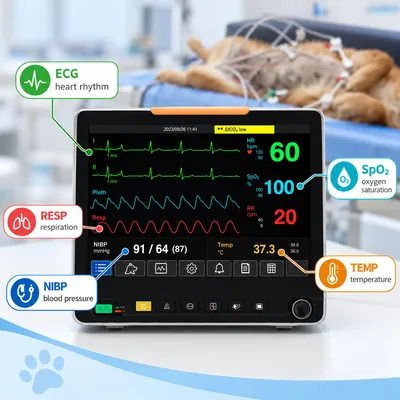
Most veterinary multiparameter monitors combine several vital sign measurements on a single display. Each parameter provides different information, and understanding those differences makes it easier to decide which configuration is appropriate.
| Parameter | What it measures | Why it matters |
|---|---|---|
| ECG | Electrical activity and rhythm of the heart | Helps identify changes in heart rate and rhythm |
| SpO₂ | Peripheral oxygen saturation | Helps assess oxygenation |
| NIBP | Non-invasive blood pressure | Provides information about arterial blood pressure |
| RESP | Respiratory rate, commonly measured through thoracic impedance | Helps track breathing rate and changes |
| TEMP | Body temperature | Helps detect temperature changes during anesthesia and recovery |
| HR | Heart rate | Provides a continuously visible measure of cardiac rate |
| EtCO₂ | Carbon dioxide at the end of exhalation | Helps assess ventilation and breathing-circuit function when used with capnography |
ECG and heart rate
ECG monitoring allows veterinary staff to follow cardiac electrical activity and identify changes in rhythm during anesthesia or other monitored procedures.
However, a normal-looking ECG waveform does not necessarily indicate that blood circulation is adequate. Electrical activity needs to be interpreted alongside blood pressure, pulse quality, and other patient findings.
When comparing monitors, look at the available ECG lead configurations, waveform visibility, alarm functions, and whether the supplied electrodes are suitable for veterinary patients.
SpO₂ and blood pressure
Pulse oximetry is commonly used during veterinary anesthesia to monitor oxygen saturation. It is a useful measurement, but sensor placement and signal quality can affect the reading, particularly in small or poorly perfused patients.
Blood pressure monitoring provides another part of the picture. Many veterinary monitors use an oscillometric NIBP method and display systolic, diastolic, and mean arterial pressure.
For practical use, the available cuff sizes are just as important as the measurement range listed in the specification sheet. A monitor may support blood pressure measurement in dogs and cats, but an incorrectly sized cuff can affect accuracy.
EtCO₂ and respiratory monitoring
Respiratory rate and capnography should not be treated as interchangeable measurements.
A monitor may display respiratory rate using thoracic impedance, while an EtCO₂ module measures exhaled carbon dioxide. Capnography adds information about ventilation and can help identify problems with the airway or breathing circuit.
The 2025 American College of Veterinary Anesthesia and Analgesia guidelines recommend continuous capnography during general anesthesia in dogs and cats.
For clinics performing general anesthesia, it is therefore important to confirm whether EtCO₂ monitoring is included in the quoted configuration or requires an additional module.
Clinical reference: 2025 ACVAA Small Animal Anesthesia and Sedation Monitoring Guidelines.
3. Don’t Overlook Animal-Specific Accessories
A veterinary monitor is only as practical as the accessories that come with it.
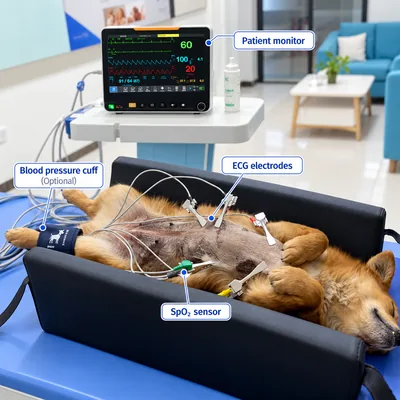
This becomes particularly obvious when moving between patients of different sizes. A blood pressure cuff suitable for a medium-sized dog may be unsuitable for a cat or a very small puppy. ECG electrodes, SpO₂ sensors, and temperature probes also need to match the patient and clinical procedure.
Before purchasing, check what is included in the standard package.
For blood pressure measurement, ask about cuff sizes and whether replacement cuffs are readily available. For SpO₂, confirm which sensor types are supplied and where they can be placed. For ECG monitoring, consider whether the clips and cables are practical for the animals your clinic treats.
Temperature probes also deserve attention. Depending on the procedure, a body-surface probe may not serve the same purpose as an esophageal or rectal probe.
This is one area where reading the accessory list can be more useful than comparing screen sizes or the number of displayed waveforms.
4. Consider How the Monitor Fits Into Your Daily Workflow
A monitor can have an impressive specification sheet and still be inconvenient during a busy surgical day.
The display should make essential readings easy to locate. Waveforms, numerical values, and alarms should be visible without requiring staff to navigate several menus.
Some clinics prefer touchscreen operation, while others value physical controls that remain convenient when staff are wearing gloves. Monitors that combine both methods may be useful in environments where different team members have different working preferences.
Alarm settings matter as well. Staff should be able to adjust appropriate limits for individual patients and distinguish between physiological alarms and technical problems, such as a disconnected sensor.
Battery life is another consideration, especially if the monitor may be moved between rooms. Internal batteries are useful when transferring patients or when temporary power disconnection is necessary, although actual operating time can vary with the configuration and battery condition.
If the clinic keeps detailed anesthesia records, check whether the device stores monitoring trends, supports data export, or offers a compatible recording option.
5. Match the Monitor to Your Type of Veterinary Practice
There is no single configuration that is ideal for every veterinary facility.
| Practice type | Equipment priorities | What to check before buying |
|---|---|---|
| General small animal clinic | Clear vital signs display, animal-sized accessories, straightforward operation | ECG, SpO₂, NIBP, temperature, and suitability for occasional anesthesia |
| Surgical and dental clinic | Comprehensive anesthesia monitoring and easy-to-read alarms | EtCO₂ capability, monitoring intervals, alarm visibility, and record keeping |
| Emergency or critical care facility | Continuous observation, flexible monitoring, reliable power supply | Monitoring options, battery backup, trends, and accessory compatibility |
| Mixed-animal veterinary practice | Equipment that accommodates varying patient sizes | Species suitability, ECG electrodes, cuffs, SpO₂ sensors, and available measurement modes |
For facilities performing general anesthesia, a basic monitor without capnography should not be assumed to provide a complete monitoring setup. The overall monitoring plan also includes trained personnel, appropriate anesthesia equipment, and direct observation of the patient.
The aim is not simply to buy the most expensive model. It is to choose a monitor that supports the level of care your facility provides today, with reasonable room for future requirements.
6. Comparing Dawei Veterinary Multiparameter Monitors
Dawei Veterinary Medical offers several patient monitoring options for veterinary practices, including the HM10, HD11-VET, and HD12-VET.
All three models offer standard monitoring parameters such as ECG, SpO₂, NIBP, respiration, temperature, and heart rate. Differences in screen operation, battery performance, data storage, and available expansion options can help clinics decide which model to evaluate.
| Feature | HM10 | HD11-VET | HD12-VET |
|---|---|---|---|
| Display | 12.1″ LCD, 1024 × 768 | 12.1″ touchscreen, 1280 × 800 | 12.1″ touchscreen, 1280 × 800 |
| Standard vital signs | ECG, SpO₂, NIBP, RESP, TEMP, HR | ECG, SpO₂, NIBP, RESP, TEMP, HR | ECG, SpO₂, NIBP, RESP, TEMP, HR |
| EtCO₂ | Optional module | Optional CO₂ module, supported interface | Reserved EtCO₂ interface; confirm module configuration |
| Data storage | At least 800 hours | At least 1,200 hours | At least 1,200 hours |
| Battery operation | At least 240 minutes | At least 300 minutes | At least 300 minutes |
| Notable features | Animal-oriented accessories, fanless design | Multi-level alarms, configurable interface | Modular internal design, additional expansion options |
Specifications are based on available Dawei technical sheets. Optional modules, accessories, and supplied configurations should be confirmed before ordering. Battery figures are manufacturer specifications, not independently verified operating-time results.
Dawei HM10: A Practical Option for Everyday Monitoring
The Dawei HM10 veterinary patient monitor brings several commonly used vital sign measurements into one device.
Its 12.1-inch display provides room for numerical readings and waveforms, while the fanless design helps reduce the entry of hair and debris into the housing. The technical specifications also describe animal-specific accessories and a built-in battery rated for at least four hours of continuous operation.
For clinics comparing monitoring equipment for routine use, the HM10 is worth considering, particularly where ease of use and everyday patient monitoring are priorities.
An EtCO₂ module is available as an option, so clinics intending to use the monitor for general anesthesia should confirm that the required capnography configuration is included.
Dawei HD11-VET: Designed for a Broader Monitoring Workflow
The Dawei HD11-VET surgical monitor offers a 12.1-inch touchscreen, monitoring data storage of at least 1,200 hours, and a battery rated for at least 300 minutes.
Its technical specifications include arrhythmia alarms, ST-segment analysis, and configurable alarm settings. It also supports mainstream or sidestream CO₂ modules.
This makes it a model to consider for veterinary practices that perform regular surgical procedures and need a monitor that can support more detailed observation and record keeping.
The actual CO₂ module and sampling accessories should be confirmed when requesting a quotation.
Dawei HD12-VET: An Option for Clinics Planning More Advanced Configurations
The Dawei HD12-VET multiparameter monitor combines standard vital sign monitoring with a modular internal design and additional configuration options.
Its 12.1-inch touchscreen, configurable display, data storage, and supported expansion features may appeal to hospitals that want to consider future equipment requirements as well as current monitoring needs.
Before purchasing, clinics should confirm the exact veterinary accessory package and which optional modules are available for their intended applications.
For more information, visit Dawei’s veterinary patient monitor product range.
7. Questions Worth Asking Before You Buy
Once you have shortlisted a few models, the next step is to check what you will actually receive.
A quotation should make it clear which parameters are included, which accessories are supplied, and whether additional monitoring modules need to be purchased separately.
It is worth asking the supplier to confirm:
- The standard monitoring parameters and any optional modules
- Compatible animal species and supplied accessories
- Blood pressure cuff sizes, SpO₂ sensors, and ECG cables
- Availability of EtCO₂ monitoring and suitable sampling accessories
- Battery specifications, warranty, and replacement consumables
- Technical support, training materials, and spare-part availability
These details make it easier to compare quotations fairly. A lower initial price may not represent better value if the clinic needs to purchase several essential accessories separately.
8. Frequently Asked Questions
What is the difference between a veterinary patient monitor and a multiparameter monitor?
A veterinary patient monitor is a general term for equipment used to measure an animal’s physiological condition. A multiparameter monitor measures several vital signs through one device, typically including ECG, SpO₂, blood pressure, respiration, temperature, and heart rate.
Does every veterinary multiparameter monitor include EtCO₂?
No. Some models support EtCO₂ through optional mainstream or sidestream CO₂ modules. Clinics performing general anesthesia should confirm the availability of a suitable capnography configuration before purchasing.
Can the same veterinary monitor be used for dogs and cats?
Yes, provided the monitor supports the intended species and is supplied with appropriately sized cuffs, sensors, and electrodes. Measurement performance and accessory requirements should be checked for different patient sizes.
Is SpO₂ monitoring enough during veterinary anesthesia?
No. Pulse oximetry provides information about oxygen saturation but does not replace blood pressure monitoring, ECG, capnography, temperature measurement, or direct patient observation.
What should a small veterinary clinic look for first?
Start with reliable core monitoring parameters, appropriate accessories for the animals treated, an easy-to-read display, and a configuration suitable for the procedures performed. If the clinic provides general anesthesia, capnography should be part of the monitoring plan.
Final Thoughts
A veterinary multiparameter monitor is a long-term part of a clinic’s equipment setup, so choosing one deserves more consideration than simply comparing the number of parameters on a product page.
Start with the animals and procedures your clinic handles. Check the essential measurements, look carefully at the accessory package, and consider whether the device will remain practical as your workload changes.
Dawei Veterinary Medical offers several monitoring configurations for different veterinary applications. If you are comparing models, our team can help clarify specifications, available options, and accessories based on your clinic’s needs.
Explore our veterinary patient monitors or contact Dawei Veterinary Medical to discuss a suitable configuration.
Post time: Oct-13-2026