


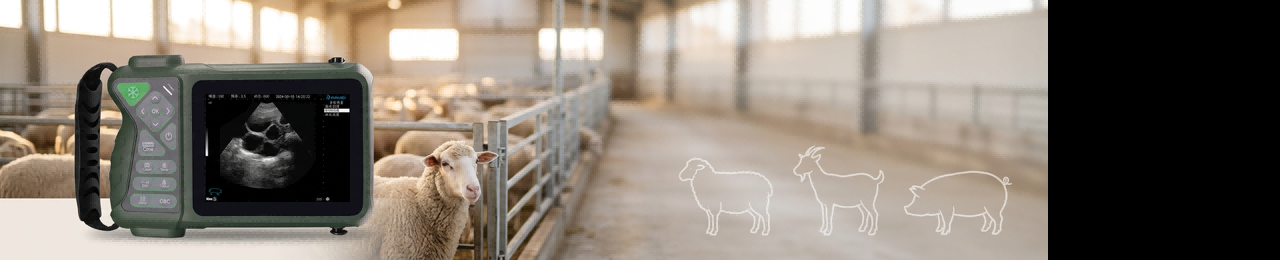
Early pregnancy detection in ewes (sheep) helps you tighten lambing groups, adjust nutrition, reduce open days, and plan labor. The right portable veterinary ultrasound can also cover does (goats) and sows (pigs)—making it a high-ROI tool for small-to-mid farms and scanning service providers.
This guide explains what makes the best portable ultrasound for early ewe pregnancy detection, what probe frequency you actually need, and how to choose a unit that works across small ruminants and swine reproduction.
Quick answer: what “best” means for ewe scanning
A best portable ultrasound for ewe pregnancy diagnosis is usually the one that balances:
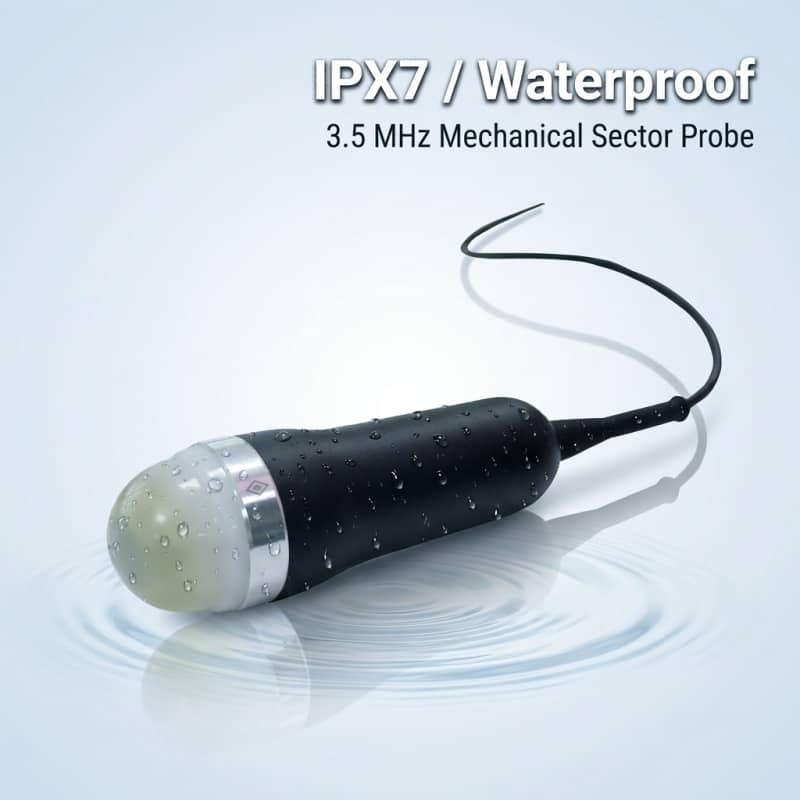
- Correct probe type & frequency for sheep body depth (typically around 3.5 MHz for transabdominal scanning)
- Fast workflow (freeze, cine loop, quick gain/depth changes)
- Outdoor durability (barn dust, cold weather, glove-friendly keys)
- Battery life for a full scanning session
- Image storage for proof, training, and records
Tip: If you’re aiming for the earliest possible detection (around the 20–40 day window), many references note it’s most accurate when performed transrectally in sheep.
When can ultrasound detect pregnancy? (Sheep, goats, pigs)
Timing depends on species, approach (transrectal vs transabdominal), operator skill, and equipment resolution.
Recommended practical scanning windows (farm routine)
| Species | Target animal keywords | Most practical window (transabdominal) | Notes |
| Sheep | ewe pregnancy ultrasound, lambing management | Day 40–70 | Efficient + accurate for pregnancy & fetal number in many systems. |
| Goats | doe pregnancy scan, goat ultrasound | Day 40–70 | Similar management window; fetal counting often easiest mid-gestation. |
| Pigs | sow pregnancy ultrasound, gilt pregnancy check | Day 24–35 | Optimal window is linked to fluid volume; avoid the “hard-to-read” period around ~38–50 days for re-checks. |
How early is “early” in ewes?
For sheep, early pregnancy (e.g., 20–40 days) can be diagnosed, and MSD Vet Manual notes that it’s most accurate when performed transrectally in that early window.
For transabdominal scanning, research summarized in a peer-reviewed paper reports pregnancy detection can be performed as early as 31 days under study conditions.
What probe is best for ewe pregnancy scanning?
3.5 MHz is the workhorse for sheep, goats, and pigs
A 3.5 MHz probe is common in farm pregnancy work because it provides enough penetration for abdominal scanning. In swine, an extension publication explains the tradeoff clearly:
- 3.5 MHz → deeper penetration, lower resolution
- 5.0–7.5 MHz → higher resolution, less depth
Mechanical sector vs convex vs linear
- Sector / mechanical fan scan: wide wedge view, good for deep targets when the precise location is unknown (common for routine pregnancy checks).
- Convex: similar wedge-style field; also common for reproductive scanning.
- Linear (3–5 MHz): frequently used in sheep/goat transabdominal work (per extension references) and can be excellent for detail when depth allows.
Practical rule: choose the probe that matches your handling system and animals. If you scan sheep + goats + pigs, a robust abdominal probe around 3–5 MHz is usually the most versatile starting point.
Buying checklist: the features that matter on-farm
1) Screen & daylight visibility
Barn scanning often happens under harsh lighting. Prioritize a screen size/brightness you can read quickly while restraining animals.
2) Cine loop & quick freeze
Cine replay helps confirm fetal fluid pockets/structures when the animal moves.
3) Battery system (and spare battery strategy)
Portable ultrasound workflows often require hours. A removable battery lets you swap and keep scanning.
4) Storage & export
Look for internal memory + USB export so you can:
- keep proof images
- train new techs
- document pregnancy outcomes
5) Animal OB measurement presets
If your unit includes built-in obstetric measurements for sheep, goats, pigs (and other common farm animals), it can speed up gestational age estimation and recordkeeping.
6) Durability & winter mode
Cold-weather work and barn dust are real. Practical modes like winter mode and standby protection reduce downtime.
Example spec profile: a portable B-mode veterinary ultrasound
Below is a spec snapshot of a portable farm scanner profile that fits pregnancy work across sheep, goats, and pigs.
| Spec item | Value (from provided technical sheet) | Why it matters |
| Display | 5.6-inch LED | Portable, quick viewing in chutes/stalls |
| Scan method | 3.5M mechanical sector (fan) scan | Wedge view suitable for reproductive scanning |
| Modes | B / B+B / 4B | Basic grayscale imaging workflow |
| Frequency options | 2.0 / 2.5 / 3.5 / 4.0 / 5.0 MHz | Flex depth vs detail across species |
| Gray scale | 256 levels | Supports contrast between fluid and tissue |
| Dynamic range | 0–135 dB | Helps manage contrast in variable conditions |
| Cine loop | ≥256 frames | Review moving frames for confirmation |
| Storage | 8 GB internal + USB export | Evidence, training, recordkeeping |
| Depth | 126–307 mm | Coverage for many farm scanning scenarios |
| Battery | 2600 mAh removable Li-ion (~3 hours) | Typical session length; swap for longer days |
| Size / weight | 240×120×45 mm / 900 g | One-hand carry for mobile scanning |
Recommended settings & technique (fast field workflow)
Sheep (ewes): transabdominal scanning quick steps
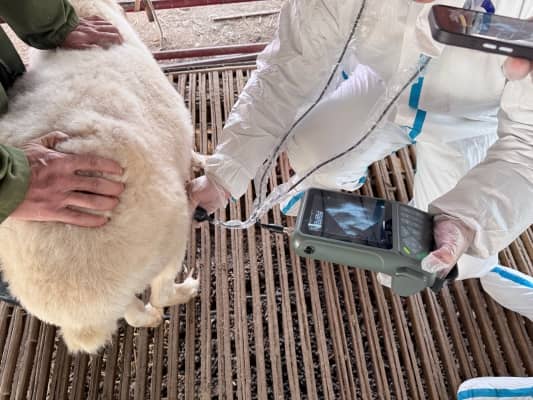
- Restrain the ewe safely (handling system matters more than any setting).
- Apply gel generously to avoid air gaps.
- Place probe on the wool-less / thin-wool area of the lower flank/abdomen.
- Start around 3–5 MHz and adjust depth until the uterus region is visible.
- Use freeze + cine to confirm fluid structures.
MSD Vet Manual describes transabdominal placement in wool-less flank areas for later imaging; for early pregnancy (20–40 days) it notes transrectal is most accurate.
Goats (does)
Similar technique to ewes. Many producers scan in the day 40–70 window to balance speed and accuracy (including fetal counting), aligning with extension guidance.
Pigs (sows/gilts)
- Scan 24–35 days post-breeding for the best fluid contrast.
- If you scan very early (around day 24) and call a sow “open,” consider re-checking a few days later.
- Avoid interpreting single fluid pockets as a definite pregnancy.
Best portable ultrasound: selection scenarios
If you only scan sheep (pregnancy yes/no)
Prioritize:
- simple controls
- strong battery
- reliable 3–5 MHz abdominal probe
If you scan sheep + goats (pregnancy + fetal number)
Prioritize:
- stable image quality
- cine loop
- quick depth/gain adjustment
If you scan sheep + pigs (mixed species)
Prioritize:
- flexible frequency options
- screen visibility
- durability and easy cleaning (biosecurity)
FAQ (portable ewe/sheep & sow/pig ultrasound)
What is the best portable ultrasound frequency for early ewe pregnancy detection?
For routine transabdominal scanning in sheep, many systems use ~3.5 MHz to balance depth and usable image quality. For very early pregnancy (e.g., 20–40 days), references note transrectal scanning is most accurate in ewes.
When should I scan ewes for pregnancy with ultrasound?
A widely recommended practical window for transabdominal scanning in sheep/goats is day 40–70, while earlier diagnosis may be possible depending on method, skill, and equipment.
When is the best time to ultrasound sows for pregnancy?
An extension publication notes the optimal time is 24–35 days following breeding, because fluid volume is high and the contrast is easiest.
Can one machine work for sheep, goats, and pigs?
Yes—if it has the right probe (3–5 MHz abdominal), adequate depth, and fast controls. You may still prefer different probes for specialized work (e.g., transrectal early scanning).
Is ultrasound gel required?
Yes. Ultrasound waves don’t travel well through air. Gel (or an approved coupling medium) improves contact and image quality.
Post time: Mar-17-2026